

A simple sign-up does not remove age and identity checks; their timing can vary, and withdrawals may bring verification into focus.
What “No ID” Means on a UK Casino Site
“No ID” sounds like a promise that a casino will let a player join, play and keep any winnings without proving who they are. In practice, the phrase often describes a narrower point: the site may not ask for identity documents during registration. That is not the same as dispensing with age and identity checks.
For gambling businesses in Great Britain, the requirement is clear: a customer’s age and identity must be verified before they gamble. A registration form that accepts basic details, or an account that opens without an immediate document request, does not cancel that requirement. The check may be less visible at first, but the claim alone says nothing reliable about what the operator will require before play.
I have seen how wording like “no ID” works in promotions and site descriptions. It catches attention by focusing on the first screen a new customer sees. If registration feels simple, the phrase may seem accurate at that moment. The missing qualification is timing. A check deferred at sign-up is still a check if it must happen before gambling can begin.
Registration is not the same as permission to play
There are separate stages that are easy to blur together: creating an account, completing verification and being allowed to gamble. A site can make the first stage feel quick without having completed the second. The important question is not merely whether the registration page asks for an upload, but whether age and identity have been verified before real-money gambling takes place.
That distinction matters when looking for an “online casino no ID verification” option in the UK. The phrase can suggest that verification is absent altogether, while the practical offer may only be that documents are not requested during the initial account setup. Those are different claims. The first would imply no check; the second says only that the check is not immediate.
The same applies to searches for a casino with no ID check or no ID required. A page may use those words to describe a sign-up experience, but they do not establish what happens later in the customer journey. The label is not a substitute for the operator’s actual terms or verification process.
Casino Guides to Licensing, Access and Payments
What counts as “ID” in the claim?
The word “ID” is often used loosely. In ordinary conversation, it can mean a physical identity document, such as a photo card or passport. In a casino description, it may be used more broadly to mean any identity verification. The wording does not tell the reader which meaning is intended.
That is why “no photo ID” and “no identity check” should not be treated as interchangeable. Not being asked to upload a photograph of a document at registration does not, on its own, show that age and identity have been verified or that they will never be checked. Nor does a smooth sign-up prove that a customer is cleared to gamble.
I would read “no document upload at sign-up” as a statement about one step, not as a promise about the whole account. A site’s wording may be technically focused on the registration page while leaving the broader question unanswered. The distinction is small in advertising copy and large in practice.
Why the wording can mislead
The phrase “no ID needed” is attractive because it sounds final. But casino checks are not defined by whether a page asks for paperwork straight away. UKGC-licensed casinos almost always require verification at some stage, and the legal requirement in Great Britain places the check before gambling. A claim about convenience cannot override that.
The difference between operators is often about when checks occur, not whether they exist. Some services may make verification less conspicuous during account creation; that does not make the verification requirement disappear. The phrase “no ID” can therefore describe the appearance of the first interaction rather than the condition for actually playing.
This also explains why a search for real-money play without ID can produce language that feels more definite than the underlying process. “No ID” may be used as shorthand for a limited sign-up check, but it should not be read as assurance that a customer can gamble without age and identity verification. Real-money access and account creation are not the same thing.
Attention: A "no ID" label often describes the timing of the registration process rather than a total exemption from age and identity verification.
A practical reading of “no ID”
The most careful interpretation is narrow: the operator may not request documents at the point being advertised. Anything beyond that needs to be established by the site’s own explanation of its checks. If the wording does not clarify whether verification is delayed or absent, it leaves the key issue unresolved.
That is especially important for phrases such as “online casino no ID needed in the UK” or “online slots with no ID”. They can imply a type of access that the headline alone cannot guarantee. In Great Britain, the relevant line is whether the customer’s age and identity have been verified before gambling—not whether an upload box appeared during registration.
A “no ID” label is therefore best understood as a claim about timing or presentation unless the operator clearly explains otherwise. It is not proof that verification has been waived, and it does not change the requirement that checks happen before play. Less paperwork at the start. Not necessarily less checking.
UKGC and Offshore Sites: The Check Is Often a Matter of Timing
The label “no ID” can make two quite different arrangements sound alike. In the UK market, the first distinction is not how a site describes its checks, but which regulatory system it operates under. A UK Gambling Commission licence places a casino inside the British framework. An overseas licence does not.
Non-UK-Regulated Casinos: Licensing and Player Risks
Remote gambling operators offering services to customers in Great Britain must hold the relevant UK Gambling Commission licence, wherever the company is based. A foreign licence is not a substitute for it. This matters because a site can be accessible from the UK without being authorised to target the British market. Access and permission are separate questions.
There is a further distinction for the person playing. UK residents can legally play at a casino licensed outside the UK where the operator is not illegally targeting the UK market. That does not make the operator UK-licensed, or bring it within the UKGC system. In my experience, that difference gets blurred in advertising: “available to UK players” describes reach, not the regulator responsible for the site.
What non-GamStop means
A non-GamStop casino is not simply a UK-licensed casino with a different account setting. These sites do not hold a UK Gambling Commission licence, and so they are not connected to the national self-exclusion database. UK-licensed operators are required to integrate with GamStop; overseas operators have no equivalent obligation under the UK system.
That is the practical meaning of “not on GamStop”. It describes the operator’s regulatory position, not a special category of identity-check-free gambling. Overseas licensing and verification are separate matters. The former identifies the regulator overseeing the business; the latter concerns the checks the operator applies to a customer. A difference in when checks happen does not establish that checks have been removed.
UKGC-Licensed Casinos
Operate within the British regulatory framework and are required to integrate with the national GamStop self-exclusion database.
Offshore Casinos
Operate under overseas licences and are not connected to GamStop, often deferring identity verification until the first cashout.
The timing can differ. UKGC-licensed casinos almost always verify customers at some stage, and UK-licensed sites often complete full KYC before the first deposit. Offshore casinos commonly defer identity verification until a first cashout, though they may use electronic checks earlier. The point is not that every offshore site follows an identical process. It is that a later check can be marketed as “no ID” even when it is only a delayed one.
A no-KYC claim therefore says little about the licence, and a foreign licence says little about whether documents will be requested later. Those are separate claims, often compressed into one sales line. Keep them separate.
Read the licence claim, not just the label
The terms “offshore”, “non-UK registered” and “non-GamStop” are often used loosely. They should not be treated as proof that a site is authorised to serve British customers. The relevant distinction is whether the operator holds the UK licence required to offer real-money gambling into the British market. A licence issued overseas does not meet that requirement.
This is also why GamStop coverage should not be mistaken for a safety rating. Its presence reflects a UKGC obligation; its absence reflects that the site is outside that particular system. It does not, by itself, establish that the operator has no licence at all, nor that a player can avoid identity checks.
The headline promise is often about timing. The regulatory status is the part that determines which framework applies. Neither phrase changes the other.
Online Casino No Registration in the UK: What It Means
Deposits, Bonuses and the Checks Behind the Offer
A deposit button can make a casino look ready for play. It does not prove that the account has passed every identity check, or that checks have been waived. In my experience, the important distinction is between being allowed to open an account, being able to add funds and being cleared to gamble. A site can treat those as separate steps.
At UK-licensed casinos, full know-your-customer checks are often completed before the first deposit. The process may therefore be visible early: account details are submitted, the operator checks them, and only then does the deposit stage open. That can feel like friction, but it is part of the operator’s gatekeeping rather than an optional extra attached to a particular payment method.
Some sites present a smoother path. An account may be created and a deposit accepted before the customer sees a request for documents. That sequence is commonly associated with offshore casinos, where checks are often delayed until the first cashout. It is a difference in timing, not evidence that the operator has no identity process. For a person comparing no ID casino sites in the UK, that distinction matters more than the wording on a deposit page.
There is also a less visible version of the same process. Offshore casinos may use electronic identity checks, or eKYC, to compare information automatically. A player might not be asked to upload a passport at registration, while the system still runs checks against the details provided. “No document upload” is not the same as “no check”. Sometimes there is no obvious pause at all; sometimes a mismatch or an incomplete result leads to a later request.
Do
- Distinguish between account creation, funding, and permission to gamble
- Treat successful deposits as payment events, not compliance certificates
Don’t
- Assume a smooth deposit process proves the account is fully verified
- Mistake promotional welcome offers for a change in identity requirements
That is why a deposit going through should be read narrowly. It confirms that the payment was accepted at that point. It does not confirm that the account has been fully verified, nor that further checks will not be required before play or at a later stage. The deposit screen is not a compliance certificate.
The same caution applies when a bonus is displayed beside the payment option. A welcome offer, a deposit match or a no-deposit promotion is a commercial inducement; it is not proof that the casino has changed its identity requirements. Promotional language can draw attention to the amount or the ease of claiming, while the account terms and verification process sit elsewhere. The offer and the check answer different questions.
I have seen this distinction get blurred in the way offers are presented. A message such as “claim now” can sound like the account is ready in every sense. In practice, it may only mean that the promotion can be attached to the account under its stated terms. It does not promise that a deposit will be accepted without checks, that gambling can start before age and identity are established, or that verification will not be requested later.
A no-deposit bonus does not change that logic. No payment being required to claim an offer says nothing by itself about whether the operator verifies identity. Nor does a “no ID” label establish that a player can use the offer, play or retain any resulting balance without checks. The promotional claim describes the route into an offer; the verification process governs whether the account is cleared for gambling.
Non-GamStop European Casinos: UK Rules Explained
The practical issue is therefore sequence. One operator may ask for information before accepting the first deposit. Another may take account details, run automated checks and ask for documents only if those checks do not settle the matter. A third may allow a deposit and then pause the account when a later review is needed. Those variations can make one casino seem less demanding at the start, even when verification remains part of the process.
I would not treat a successful first deposit as a reliable test of whether an account is “no ID”. It tells very little about what happens when a check is incomplete, when account details need confirmation, or when the operator reaches a later review point. The same is true of a bonus appearing in the cashier: it shows that an offer is being presented, not that compliance has been switched off.
For the UK market, the central point is simple. UK-licensed sites often put full KYC before the first deposit, while offshore sites may defer fuller checks. Yet even an offshore casino can run electronic checks without asking for documents at sign-up, and a delayed request remains possible. The difference is often when the check becomes visible. Not whether it exists.
A clean-looking cashier can be reassuring. It can also be misleading. A deposit is a payment event; a bonus is an offer; verification is a separate control. Keeping those three things apart is the only sound way to interpret a “no ID” claim at the point of deposit.
UK-licensed sites typically require full know-your-customer (KYC) checks before the first deposit, whereas offshore sites may use electronic eKYC or defer checks until withdrawal.
Playing Slots Without an ID Check: What the Claim Leaves Out
“Slots without an ID check” sounds like a feature of the game: choose a reel, press spin and skip the paperwork. In practice, the slot itself does not decide whether identity checks apply. The relevant question is whether the activity is real-money gambling and whether the operator has completed the checks required before play.
For online gambling businesses in Great Britain, age and identity must be verified before a customer gambles. That requirement applies to slot play just as it applies to other casino games. A site cannot turn a real-money spin into an exception by labelling its service “no ID” or by making registration appear simple.
The game does not create an exemption.
I have seen how the wording is chosen. “No ID” can describe a sign-up flow that does not immediately ask for documents. It can also be used broadly in marketing, leaving the impression that checks will never occur. Those are different claims. A player may be able to open an account without uploading documents at that moment; that does not establish that the operator has verified age and identity, or that it can let the player gamble without doing so.
This is where “slots no ID needed” becomes misleading when read as a promise about the whole playing experience. A short registration form is not the same thing as permission to play without verification. The check may be handled in a way that is not visible as a document-upload step, but the requirement remains. What matters is that the operator verifies the customer before gambling begins, not whether the process resembles a paper form.
Non-GamStop Curacao Casino Sites: UK Licensing
The same distinction matters for searches about real-money slots. If money is being staked on spins, the activity is gambling; it is not made verification-free by the fact that a game loads quickly or the account interface asks for little information. A page that says “no ID needed” may be describing the point at which documents are requested, rather than removing the checks altogether. The phrase compresses two different ideas into one.
Timing is not absence.
Free play is another source of confusion. A slot offered in a free-play mode is not the same proposition as a real-money slot session. The phrase “no ID needed” attached to a free game does not demonstrate that real-money play is available without age and identity verification. Nor does a page mentioning free spins establish that the same terms apply to ordinary play. Promotional wording belongs to the offer; it cannot cancel the requirement that applies when gambling takes place.
This is why phrases such as “free slots with no deposit” need to be read carefully. They may refer to a mode of play or a promotion, but the words alone do not say what checks apply before real-money gambling. “No deposit” is not another way of saying “no verification”. A slot can be available to view or play in a limited format while the operator still has to verify identity and age before gambling with money.
Legal Requirement
In Great Britain, age and identity must be verified before a customer gambles, regardless of whether the service is labelled "no ID."
An operator’s use of automated checks does not change that distinction either. From the player’s side, an account may appear to move through registration without a document request. That visible experience is not proof that the operator has waived verification. The check can be less conspicuous than a manual upload, but the legal point remains the same: age and identity must be verified before the customer gambles.
I would treat “no ID” as a description of process only when the wording makes clear what stage it refers to. If it suggests that real-money slot play can happen with no age or identity verification at all, it conflicts with the rule for online gambling in Great Britain. If it means that documents are not requested at the first screen, it says much less than the headline implies.
The practical distinction is simple, though the advertising often blurs it. A slot may be easy to access; that is not the same as being exempt from checks. A free-play label does not establish the conditions for real-money spins. And a missing upload prompt at registration does not prove that verification will never be required.
A quiet process is still a process.
Free Spins and “No ID Required” Promotions
“Free spins” describes how a promotion is delivered, not what the casino has checked about the account. The phrase may mean that spins are offered without a cash deposit, or that a promotional offer is displayed before the operator has asked for identity documents. Neither interpretation establishes that a person can play real-money casino games without age and identity verification.
Anjouan casino licence in the UK: what it means
I have seen promotional wording do a lot of work in a small space. “No ID required” sounds like a promise about the whole customer journey. In practice, it may describe only the sign-up screen: no document upload is requested at that moment. That is not the same as an operator confirming that checks will never happen. Timing, not exemption.
What the wording can—and cannot—mean
For a UK-licensed casino, the central distinction is straightforward. The operator must verify a customer’s age and identity before that customer gambles. A promotion cannot suspend that requirement. A site might complete some checks electronically or at a different point in the account process, but the absence of an immediate document request should not be read as permission to start playing first and verify later.
This matters when an offer is described as casino free spins with no ID required. The wording may be shorthand for a limited step in registration, or it may come from a platform outside the UK Gambling Commission’s system. Those are materially different situations. A UK-facing operator offering real-money gambling must hold the relevant UK licence; an overseas licence does not make an unlicensed offer lawful for the British market. A promotion’s headline does not settle that question.
“Free” also refers to the promotional spins, not to every condition attached to them. The offer may have eligibility rules or terms that determine who can use it and what happens to any resulting balance. Those details belong to the promotion’s terms, not to the headline. A free-spin label does not establish that winnings can be withdrawn without conditions, nor that an account has passed the operator’s checks.
Promotional Terms
Free spins and no-deposit bonuses are commercial inducements; they do not override the operator’s obligation to verify identity before real-money gambling takes place.
I treat the headline as a sales label. The terms carry the mechanics.
Free spins are not a verification status
Searches for no-ID casino free spins often combine two separate ideas: a promotional benefit and a reduced sign-up process. One does not prove the other. A site could advertise spins while still applying identity checks at another point. Conversely, a page that asks for no documents immediately has not demonstrated that the account is fully verified.
That remains true for slots free spins promoted as “no verification”. The wording may be intended to attract people who want to start quickly, but speed at registration is not the same as the right to gamble without checks. In Great Britain, age and identity verification must be completed before gambling. UKGC-licensed casinos almost always require verification at some stage, and the wider difference between UK-regulated and offshore sites is often when checks occur—not whether checks exist at all.
The same distinction applies to an online casino advertising real-money play without an ID check. If the offer appears to promise real-money gambling before age and identity have been verified, the claim should not be treated as a reliable description of a lawful UK-licensed process. Promotional copy is not a substitute for the operator’s licence status or its actual account conditions.
Crypto does not rewrite the offer
A crypto casino may use language suggesting that a wallet-based payment makes registration more private or removes paperwork. That concerns a payment route, not the operator’s obligations around identity. Using cryptocurrency does not turn a “no ID” promotion into proof that checks have been waived, and it does not make gambling transactions invisible.
The relevant question is still what the operator means by “no ID”. Does the phrase refer to documents not being requested at sign-up, or does it imply that no age and identity checks apply at all? For a UK-licensed casino, the latter cannot be reconciled with the requirement to verify before gambling. For an offshore platform, a promotional claim does not bring the site into the UK regulatory system or establish that it may lawfully target British customers.
I would separate three things that advertising often compresses into one: free spins, the timing of account checks, and the operator’s authority to serve the market. The offer itself answers only the first. The wording about documents may say something about the second, but it cannot prove that checks will never arise. Neither phrase answers the third.
That is why “no ID required” should be read narrowly, not as a guarantee attached to free spins. The offer may be available without an immediate document upload; it does not establish that a person can gamble for real money without identity verification. A headline is not clearance.
Why Withdrawals Commonly Trigger Verification
A casino can accept a registration and allow deposits before asking for identity documents, then pause a withdrawal until checks are complete. That can look inconsistent from the outside. In practice, the point at which a payment is requested is often when the operator makes verification a condition of releasing money. Offshore casinos commonly place that check before the first cashout; “no-KYC” in the marketing does not mean documents cannot be required.
Withdrawal Process
Approval Stage
The casino reviews the withdrawal request and may require identity documents, proof of address, or source-of-funds information.
Approval Decision
The operator decides whether to approve the request based on the completed verification checks.
Payment Settlement
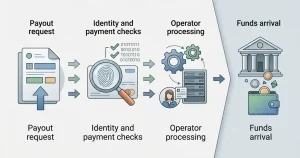
Once approved, the funds move through the selected payment method’s processing route to the player.
I have seen the distinction matter more than the label. A site may defer a full review while an account is being opened, yet still reserve the right to check the account when funds are due to leave. Most non-GamStop casinos still ask for identity documents before approving a withdrawal, despite promoting themselves as no-KYC. The claim describes a possible delay in checking, not a promise that a real-money balance can be withdrawn without verification.
The request may go beyond a photo ID. A specialist review describes checks that can include proof of address, contact details and source-of-funds information, as well as identity documents. The precise request depends on the operator’s process and the account being reviewed; the phrase “no ID verification withdrawal casino” does not settle that question. A document request is not, by itself, proof that the withdrawal has been rejected. It means the casino has not yet cleared its own approval stage.
That stage is separate from payment settlement. First, the casino reviews the withdrawal and decides whether to approve it. Only after approval does the payment move through the selected method’s processing route. A delay before approval is therefore different from a transfer that has been approved but is still being settled. The two can be mistaken for one another when a cashier shows a pending status without explaining where the request is held.
The distinction also explains why a quick deposit says little about how quickly cash can be released. Depositing and withdrawing are separate transactions, and the operator may apply checks at the latter point even if the earlier transaction went through without a document request. “Fast payout” describes neither the completion of verification nor the payment provider’s settlement time unless the terms clearly define what the timing covers.
For anyone comparing no-ID withdrawal claims, the useful detail is not simply whether the site asks for documents at registration. It is whether the withdrawal rules allow checks before approval, what kinds of evidence may be requested, and how the operator describes the steps after approval. Those terms are more informative than a banner suggesting that verification never happens. The label is not the process.
Two separate gates.
Pay by Mobile: Deposit Method, Not a Cash-Out Route
Pay by mobile is a way to fund an account, not a route for receiving winnings. At offshore platforms, Boku and comparable services are described in specialist reviews as deposit-only, so the payment method should not be mistaken for a complete cash-in and cash-out option.
The distinction matters in practice. A mobile charge may appear on a phone bill or be taken from a prepaid balance, but that does not make it a withdrawal channel. The operator’s cashier can list a method for deposits while providing no matching option for payouts. Different job. Different rails.
Attention: Pay-by-mobile services like Boku are typically deposit-only and cannot be used as a route for receiving winnings.
There is also a separate hurdle before a payment reaches the casino. A UK bank can question or hold a transaction to an offshore gambling operator, or refuse to process it; some payments may be blocked altogether. That decision sits with the bank or payment system, not with the mobile-payment brand. A method being visible on a casino’s cashier page is not confirmation that a particular transaction will go through.
I treat the payment list as a description of possible deposit routes, not a promise of access. The key checks are whether the method is explicitly limited to deposits and whether the bank will permit the transaction. Mobile billing can simplify the first step; it does not remove payment restrictions or create a cash-out route.
Crypto Payments and Withdrawal Timing
Crypto can shorten the payment leg, but it does not turn a withdrawal into an automatic transfer. Specialist casino reviews have reported that some offshore operators process cryptocurrency withdrawals within minutes; another stated window for serious operators is one to six hours. Those are reported processing times, not a promise that every request will clear within them.
The distinction is between the casino approving a payout and the cryptocurrency transaction being processed afterwards. A quick network transfer cannot speed up an operator’s internal review, and a pending request may still be held while account checks are completed. “Fast crypto payouts” describes a possible payment route, not a guarantee of immediate access to funds.
Nor does paying or withdrawing in Bitcoin or another cryptocurrency remove identity checks. Offshore casinos may ask for documents before approving a first withdrawal, even where their marketing uses “no-KYC” language. The payment method does not change that. A crypto transaction should not be treated as invisible to tax authorities either.
I have seen the speed claim do useful work in advertising: it makes the payout process sound like a single step. It is not. The operator’s approval comes first; the payment method matters only after that decision. So the stated window is best read as a guide to processing at a particular operator, not a substitute for checking its withdrawal terms or verification rules.
What “Best” Means When Verification Can Still Apply
For UK players considering casinos advertised as requiring no ID verification, check the operator’s verification terms before depositing. The details available here cover payout speed only and do not confirm whether identity checks are required.
1. SlotoSport
Payout speed: 1-3 business days The supplied payout speed is 1–3 business days. No information is provided about its ID verification requirements.
2. EvoSpin
Payout speed: 1-3 business days The supplied payout speed is 1–3 business days. No information is provided about its ID verification requirements.
3. BeOnBet
Payout speed: 1-3 business days The supplied payout speed is 1–3 business days. No information is provided about its ID verification requirements.
4. Dieselwin
Payout speed: 1-3 business days The supplied payout speed is 1–3 business days. No information is provided about its ID verification requirements.
5. x3bet
Payout speed: 1-3 business days The supplied payout speed is 1–3 business days. No information is provided about its ID verification requirements.
6. Jetsetspins
Payout speed: 1-3 business days The supplied payout speed is 1–3 business days. No information is provided about its ID verification requirements.
7. SpinFormula
Payout speed: 1-3 business days The supplied payout speed is 1–3 business days. No information is provided about its ID verification requirements.
8. NightLuck
Payout speed: 1-3 business days The supplied payout speed is 1–3 business days. No information is provided about its ID verification requirements.
9. Zombillion
Payout speed: 1-3 business days The supplied payout speed is 1–3 business days. No information is provided about its ID verification requirements.
10. Revery Play
Payout speed: 1-3 business days The supplied payout speed is 1–3 business days. No information is provided about its ID verification requirements.
“Best” is doing too much work in the phrase “best no-ID casino”. In practice, the label can describe a site that postpones document checks, not one that has removed them. I have seen that distinction get lost in comparison tables: a shorter sign-up process is presented as if it were a promise about the whole account.
A useful comparison starts with what the claim actually covers. Does it refer only to registration, or does the operator explain when identity checks may occur later? The two are not interchangeable. UKGC-licensed casinos almost always verify customers at some stage, while the contrast with offshore sites is often about when checks happen, rather than whether they happen at all.
That makes “no ID” a poor measure of quality on its own. A site may ask for less information at the outset and still require verification later. A ranking that treats delayed checks as absent checks is not comparing like with like. It is comparing a sign-up claim with the wider account process.
I would read a ranked operator block as a set of separate criteria, not as proof that any entry lets someone gamble without verification. The licence information, payment terms and stated verification approach answer different questions. None should be collapsed into a single “best” badge. Clear wording matters more than a frictionless first screen.
There is also a regulatory distinction behind the label. An offshore operator is not a UKGC-licensed casino, and a claim about reduced checks does not change that status. So the best no-ID casinos in the UK, if “best” means anything useful, are not simply the ones asking for the least at registration. They are the ones whose terms make the timing and scope of checks legible, without implying that checks have vanished.
A modest claim. A meaningful one.
What is the maximum withdrawal without ID?
There is no stated withdrawal amount that can be cashed out without verification. Offshore casinos typically require identity documents before approving a first withdrawal.
Is it legal for UK players to use non-UK-registered casinos?
Yes, UK residents can legally play at casinos licensed outside the UK, provided the operator is not illegally targeting the UK market. An overseas licence is not a substitute for the UK Gambling Commission licence required to offer gambling services to customers in Great Britain.
Do non-UK-registered casinos accept credit cards?
Yes, offshore casinos routinely accept Visa and Mastercard, although UK banks may flag, decline, delay or block payments to them. Credit card gambling is banned at UK-licensed operators.
Material created by the team Rolletto