

A practical guide to UK licensing, account checks, bonus terms and payment claims, with marketing kept separate from evidence.
What a UK Gambling Commission licence actually tells you
A “trusted” label is a judgement, not a regulatory status. For an online casino serving customers in Great Britain, the first concrete question is whether the operator holds the relevant UK Gambling Commission licence. The rule follows the market being served: a business cannot avoid it by placing its headquarters, servers or company registration elsewhere.
That matters because an online gambling business can look distant from the customer. Its corporate address may be outside Britain, and the people running it may work in another country. Those details do not change the licensing boundary. If it provides remote gambling facilities to consumers in Great Britain, it falls within the Gambling Commission’s remit for that activity and needs the appropriate licence.
I have seen location used in marketing as though it settled the question: an overseas address is presented as a sign of scale or international reach, while a domestic address is treated as reassurance in itself. Neither tells the whole story. The useful distinction is not where the company is based, but whether the operation has the permission required to serve this market.
USA Casinos for UK Players: Licensing and Risks
A UK Gambling Commission licence therefore gives a specific answer. It indicates that the operator is authorised under the British regulatory system for the relevant gambling activity. It is not a general certificate that every aspect of a site will suit every customer, nor does the word “licensed” make a promotional claim such as “most trusted” objectively true. The licence is evidence of regulatory status; trust is a broader conclusion that has to be judged against evidence.
That distinction can get blurred on casino pages. A brand may use British imagery, display prices in pounds or describe itself as UK-facing. Those signals may help identify the intended audience, but they do not substitute for the required permission. Likewise, a company’s overseas incorporation does not, by itself, disqualify it from serving Britain. The licensing requirement applies because of the service offered to consumers here, not because the operator has a particular nationality.
Non-UK-Regulated Casinos: Licensing and Player Risks
The regulator’s role is also narrower than some advertising language suggests. The Gambling Commission oversees remote gambling provided to people in Great Britain. Its licence is not a universal endorsement of a company, and it should not be read as a promise that a customer will never encounter a dispute or an unsatisfactory decision. It establishes that the operator is subject to the applicable licensing regime. That is an important baseline, not a guarantee of outcomes.
One practical part of that regime is participation in GAMSTOP. Online operators covered by the Commission’s Great Britain system have to take part in the national self-exclusion service; that requirement became compulsory on 31 March 2020. This is more than a logo to place in a footer. It connects the operator to a shared mechanism intended to prevent people who have self-excluded from continuing to gamble with participating operators. The underlying point is that a licence carries obligations, not merely permission to use a reassuring badge.
I would treat the licence as the start of a trust assessment, rather than its finish. In a real check, the operator’s legal identity and the customer-facing name may not be identical, so the record needs to be read carefully. A familiar brand name is not itself proof of licensing, just as an unfamiliar corporate name is not proof that a site is outside the system. The relationship between the service and the licensed entity matters. That is a question of evidence, not design.
The same care applies to claims such as “best trusted online casino UK”. The phrase combines a regulatory-sounding word with a ranking claim, but the licence only establishes authorisation within its scope. It does not rank operators against one another. A site can be licensed without being the best choice for a particular person; a polished trust claim cannot make an unlicensed service compliant.
There is a simple reason this baseline deserves attention before considering a casino’s presentation. A UK-facing online casino is not outside the rules merely because its company is based abroad. Conversely, a British-sounding name or local currency does not establish that the required licence exists. The regulatory question concerns the activity and the customers it serves.
A UK Gambling Commission licence indicates that an operator is authorised under the British regulatory system and must participate in the national self-exclusion service, GAMSTOP.
So a UK Gambling Commission licence tells something precise: the operator has the relevant authorisation to offer remote gambling within the Commission’s Great Britain regime and is subject to its associated requirements, including participation in GAMSTOP. It does not settle every question about the brand, the quality of its service or the strength of its “trusted” claims. Start with permission. Then read the rest as separate evidence.
Real-money play starts with checks and limits
A real-money account is not ready for use simply because a registration form has been accepted. Under UK rules, the operator must verify a customer’s identity before allowing a deposit or play. That puts identity checks at the start of the account journey, rather than leaving them as an optional task after a balance has been built up.
In practice, verification can involve a passport or driving licence and a recent utility bill. The operator is checking that the account belongs to the person named on the documents and that the details supplied at registration match. It is a basic control, but it can also determine whether a deposit or game session is available at all. There is no real-money play first and paperwork later.
That distinction matters when an account looks open but remains restricted. A welcome message or a visible cashier does not mean every account check has cleared. Operators may ask for information before funds can be deposited or gambling can begin; the purpose is to establish identity before money is put at risk. A sensible account process makes clear what remains to be completed, rather than treating verification as fine print.
Casino Without a UK Licence: Rules and Risks
Limits are part of the account, not a footnote
The operator must prompt a new customer to set a financial limit before the first deposit. Account-level limit controls must also remain accessible. These controls are meant to let a customer set boundaries around gambling expenditure from within the account, not merely accept a suggested figure during registration and then lose sight of it.
The timing of a change matters. A reduction to a limit takes effect immediately; an increase is subject to a cooling-off delay. That difference is deliberate. A person who wants to tighten a boundary should not have to wait, while a decision to loosen it cannot instantly undo the protection. The control works only if it is visible and understandable, so the account should show the current setting and make the route to changing it clear.
From the operator’s side, these controls are not decorative features. They shape what the account will permit, and their timing can affect whether a customer can continue spending at the same level. I have seen the difference between a control that is easy to find and one that exists only in a menu no one can locate. The wording and placement are part of the protection.
Online slots have fixed stake rules
Slot play has additional limits. The maximum stake per spin is £5 for players aged 25 and over, and £2 for those aged 18 to 24. The lower cap for younger adults remains in place even though the general cap for older adults changed: the £5 limit for all adults took effect on 9 April 2025, while the separate £2 restriction continues for the younger age group.
Players 25+
Maximum stake per spin is £5.
Players 18-24
Maximum stake per spin is £2.
Spin Duration
Each online slot spin must last at least 2.5 seconds.
These are stake ceilings, not recommendations about how much to gamble. A game’s displayed stake must stay within the applicable cap; changing the account’s financial limit does not change the slot limit. Nor does a casino’s use of “trusted” or “real money” in its promotional language alter the rules that govern the game.
Other slot controls affect how play unfolds. Autoplay is banned in Britain, and each online slot spin must last at least 2.5 seconds. Those requirements constrain the pace and automation of play; they are not a substitute for an account-level spending limit. Each control addresses a different part of the experience.
The practical order is therefore clear: identity must be verified before depositing or playing, a financial limit must be set before the first deposit, and slot stakes and play mechanics remain subject to their own rules. None of these measures tells a customer how enjoyable a game will be. They establish what an account and a slot game are allowed to do. Basic, but consequential.
A site’s brand is not the same as its licence holder
A casino’s name is the part customers see; the licence holder is the legal entity recorded by the regulator. Those names may differ without the relationship being hidden or improper. The useful evidence is the link between the customer-facing domain and the company responsible for operating it—not a familiar logo, a polished footer or a brand name repeated across review pages.
I have found it more useful to treat the UK Gambling Commission’s public register as an identity map than as a directory of brands. Its domain entries can connect a web address to an operator account, while the operator record gives the company’s legal name and account number. That makes it possible to check whether a claim about a site has a corresponding regulatory entry. A brand name on its own does not do that job.
Casino Sites Not on GamStop: UK Rules and Checks
For example, a check of the regulator’s public domain register identifies leovegas.co.uk as an active UK-facing domain under operator account 39198. The matching operator record lists LeoVegas Gaming PLC under that same account number. The useful detail is the matching account reference: it connects the domain to the legal entity, rather than leaving the relationship to inference from the brand.
This distinction matters because customers can encounter a site through a trading name, a domain, an app listing or an affiliate review. Those labels are not interchangeable. A review may describe a brand accurately while saying little about the company that holds the relevant account. Where the legal entity is not named, the reader is left with an impression rather than a verifiable link.
White-label arrangements add another layer. A regulator-register check links 333casino.com to Grace Media (Gibraltar) Limited, operator account 57869, and identifies the domain as a White Label domain. That entry is more informative than simply seeing 333 Casino named on a homepage: it shows how the regulator records the domain in relation to the operator. It does not mean the brand name and the licence holder are the same thing.
The wording “White Label” describes the registered relationship; it is not a separate endorsement of the customer-facing brand. In practice, a brand can provide the shopfront while an operator sits behind it. The register’s entry is therefore a starting point for identifying responsibility, not a reason to assume that every service, promotion or customer interaction is identical across sites using a similar arrangement. Names matter. So does the role attached to each name.
Do
- Check the UKGC public register for the legal entity
- Match the site domain to the operator account
- Verify the operator’s legal name against the record
Don’t
- Rely on a familiar brand name as proof of licensing
- Assume a polished footer confirms regulatory status
- Use outdated screenshots instead of the live register
When checking a casino’s public identity, consistency is the point. The site domain should correspond to a domain entry, and the operator named in the relevant record should correspond to the company account. A footer that gives a company name but no clear relationship to the domain leaves a gap. So does a review that treats the brand name as if it were automatically the licensed company.
This is also why “trusted casino” language can be misleading when it relies only on recognition. Familiarity is not a register entry. Nor does a cluster of reviews repeating the same brand description create independent confirmation of who operates the site. I look for the legal name and the account connection, then keep those separate from marketing language.
Register information can change, so a saved screenshot or old review may not reflect the current record. The check needs to be made against the live public register, using the actual domain and the operator’s legal name rather than relying on a search result or a brand page alone. A match is concrete evidence of the recorded connection. It is not a universal verdict on the site’s quality.
That is the distinction worth keeping: the brand tells the customer what the casino calls itself; the register can show which company is attached to the domain. When those identities line up clearly, the relationship is easier to assess. When they do not, the missing link should not be filled in by assumption.
“Best” is a claim; the evidence is the point
When assessing a UK casino, payout speed is one practical detail to consider alongside the information available about the operator. The entries below give the stated payout timeframe for each option.
1. SlotoSport
Payout speed: 1-3 business days SlotoSport has a stated payout speed of 1–3 business days.
2. EvoSpin
Payout speed: 1-3 business days EvoSpin has a stated payout speed of 1–3 business days.
3. BeOnBet
Payout speed: 1-3 business days BeOnBet has a stated payout speed of 1–3 business days.
4. Dieselwin
Payout speed: 1-3 business days Dieselwin has a stated payout speed of 1–3 business days.
5. x3bet
Payout speed: 1-3 business days x3bet has a stated payout speed of 1–3 business days.
6. Jetsetspins
Payout speed: 1-3 business days Jetsetspins has a stated payout speed of 1–3 business days.
7. SpinFormula
Payout speed: 1-3 business days SpinFormula has a stated payout speed of 1–3 business days.
8. NightLuck
Payout speed: 1-3 business days NightLuck has a stated payout speed of 1–3 business days.
9. Zombillion
Payout speed: 1-3 business days Zombillion has a stated payout speed of 1–3 business days.
10. Revery Play
Payout speed: 1-3 business days Revery Play has a stated payout speed of 1–3 business days.
“Best” is easy to print beside a casino name. It says nothing, by itself, about who operates the site, whether the operator holds the relevant UKGC Licence, or how it has handled its obligations. I treat it as advertising language, not a finding. “Trusted” needs something firmer behind it.
A licence is a starting point, not a clean bill of health for every decision an operator makes. Enforcement records add another kind of evidence: they show that a regulator identified a problem and what action followed. That history cannot establish that every part of a service is unsafe, any more than a promotional award can prove that it is dependable. It gives the claim context.
One concrete example is the UK Gambling Commission’s action against Grace Media. On 26 June 2025, the Commission imposed a £60,000 financial penalty for breaches involving self-exclusion and consent for direct electronic marketing. The useful point is not that one penalty settles whether a brand deserves trust. It is that self-exclusion and marketing consent are substantive customer-protection issues, not minor details to be obscured by a “best” label.
I have seen how broad superlatives work in commercial copy: they compress a complicated service into a reassuring word. That may make a page easier to scan, but it does not tell a customer what has been checked. A trust assessment should separate the claim from its support: look for a verifiable regulatory record, read the nature of any enforcement action, and note whether the claim explains its basis. A bare badge or ranking does none of that.
Regulatory Enforcement
Regulatory penalties, such as the £60,000 fine imposed on Grace Media for self-exclusion and marketing breaches, highlight substantive customer-protection failures.
There is also a difference between a casino operator and its games. A game title or familiar provider name cannot establish that the casino offering it is trustworthy; the regulatory question concerns the operator and the service, not the appearance of a particular table or slot. “Trusted casino games” is therefore an imprecise promise unless it explains what, exactly, is being assessed.
The phrase “most trusted UK casinos” sounds like a comparison, but a comparison needs a stated method and evidence that can be checked. Without those, the superlative is only a sales distinction. A useful review makes its criteria visible and keeps its conclusions within what the records support. It does not turn a past enforcement decision into a permanent verdict, or a current licence into proof that nothing can go wrong.
That is the distinction I rely on: promotional confidence is not regulatory evidence. Check the record; then judge the claim.
Crypto claims still sit inside the licensing boundary
A cryptocurrency payment option and permission to offer gambling are separate things. One describes a way money might move; the other concerns whether an operator may provide remote gambling to consumers in Great Britain. Treating the first as evidence of the second is a category mistake.
I have seen payment language do a lot of work in casino marketing. A label such as “crypto-friendly” can suggest modernity, privacy or freedom from ordinary restrictions, but it says nothing by itself about the operator’s regulatory position. It does not establish who runs the service, where it is based, or whether it holds the authority required for the market it serves. The wording sells a feature. It is not a licence.
VPN-Friendly Casinos in the UK: What the Label Means
The rule for Great Britain does not turn on the payment method. A remote gambling business offering facilities to consumers there needs the relevant UK Gambling Commission licence, even if the business is based elsewhere. So a claim aimed at people in England, Scotland or Wales cannot be assessed by asking only whether a casino mentions digital assets. The central question remains whether the operator is licensed for the activity it offers in that market.
That distinction matters because a payment page can feel more concrete than regulatory language. It may name a token, describe a wallet route or make a deposit process sound uncomplicated. Those details, even if accurate, concern transactions. They do not prove that the underlying gambling service sits within the British licensing system. Nor does a British-sounding brand or a polished site change the licensing requirement.
“Trusted” is also not a payment feature. It is a judgement that needs support from evidence relevant to the operator and the market. A payment claim might be one detail in a broader assessment, but it cannot stand in for the required licence. In practical terms, the question is not whether crypto appears in the casino’s wording; it is whether the business offering remote gambling to Great Britain consumers has the relevant UKGC Licence.
I would keep those checks in separate mental boxes. First, what does the operator claim about payments? Second, what does its regulatory position establish? Combining the two creates a false shortcut: a modern-sounding payment option becomes mistaken for proof of legitimacy. That shortcut is convenient for advertising and weak for judgement.
Attention: A cryptocurrency payment option is a transaction feature and does not serve as evidence that an operator holds the required UK Gambling Commission licence.
The same applies to phrases such as “top trusted casinos” when they are attached to payment-led claims. A ranking or endorsement cannot alter the licensing boundary, and the presence of a particular payment method cannot do so either. The method may affect how a transaction is handled; it does not decide whether the operator is entitled to offer remote gambling to consumers in Great Britain.
Different question. Different evidence.
“Trusted UK casino” needs a jurisdiction check
“UK” is a geographic label, not a precise description of the Gambling Commission’s reach. Under the Gambling Act 2005, the Commission’s remit covers England, Wales and Scotland. Northern Ireland is not within that remit for remote-gambling provision. A statement that a casino is trusted across the UK can therefore blur a distinction that matters: the same regulator does not oversee remote gambling throughout the whole country.
I have seen broad labels do a lot of quiet work. “UK casino” can sound like a single regulatory category, when the legal position depends on which part of the UK is involved. For customers in Great Britain, the Gambling Commission is the regulator for remote gambling offered to them. Northern Ireland is outside that specific UKGC remit. That boundary should not be stretched into a claim that the Commission’s licence covers every UK jurisdiction.
Nor does the distinction tell the whole story about a company. A brand may use UK-wide language, but the phrase alone does not establish where its services are regulated or which authority has jurisdiction. The wording is promotional shorthand, not proof of a single national approval. The jurisdiction has to be understood before a trust claim can be interpreted.
This matters because regulatory statements are often compressed into badges, footer text or a sentence on a casino page. A UKGC reference concerns the Commission’s role in Great Britain; it should not be read as a ruling on provision in Northern Ireland. Equally, the fact that Northern Ireland falls outside the Commission’s remit for remote gambling does not make a Great Britain licence a substitute for whatever rules apply there. Two distinct points. Easy to conflate.
Non-UKGC Licensed Casinos: Rules and Risks
In practice, a careful description separates the territory from the regulator. “Licensed by the UK Gambling Commission” identifies an authority and its remit; “available in the UK” is a broader market claim. They are not interchangeable. When a page uses “trusted UK casino” as if it settled both questions, the wording has gone further than the jurisdictional fact supports.
That distinction is especially useful when comparing statements from operators, review pages and other material that use “UK” loosely. The key issue is not whether a label sounds reassuring, but what it actually identifies: a service for Great Britain under the Gambling Commission’s remit, or a wider claim that also includes Northern Ireland. The phrase alone cannot answer that.
Reviews, bonus terms and the cost hidden in the maths
A bonus headline shows the amount offered, not the amount of play attached to it. The wagering condition sets the required stake before bonus funds can be withdrawn, and the multiplier applies to the bonus amount stated in the terms. A specialist review illustrates the calculation with a £20 bonus and 10x wagering: that means £200 in total stakes. The figure is turnover, not a fee and not a promise that the balance will reach a particular amount.
Bonus Wagering Calculation
Identify the bonus amount
Take the offered bonus, for example £20.
Apply the multiplier
Multiply the bonus by the wagering requirement, such as 10x.
Calculate total stakes
The result is the total turnover required before withdrawal, which in this case is £200.
I have found that the important detail is often the base used for the calculation. Terms may refer to the bonus, or define another basis; a review that repeats the headline without explaining the calculation leaves out the part that determines how much play is required. “Free” is a label. The conditions do the accounting.
Eligibility comes next. A specialist review describes welcome deals as often restricted to new customers, limited to one per household, and potentially unavailable with some payment methods, including e-wallets. Those are conditions to confirm in the offer itself, not universal rules. A review should make clear when it is describing one promotion rather than every offer at the casino.
Expiry changes the practical value too. A specialist review reports that bonus funds and free spins commonly have a fixed validity period, with examples ranging from 7 to 30 days. The exact deadline belongs to the current promotion’s terms. If it is buried in a general bonus page, a review should say so rather than imply that the offer stays available indefinitely.
Game contribution can make the wagering calculation less straightforward. A specialist review describes slots as contributing 100% towards wagering, while live tables and blackjack may count at a lower rate or not count at all. A stake that appears to advance the requirement may therefore make little or no progress if the game has a reduced contribution. The table of eligible games matters as much as the multiplier.
Merkur Casino Online UK: Games, Sites and Safety
When I read trusted casino reviews in the UK, I look for the arithmetic and the exclusions together: bonus basis, eligible customers, payment restrictions, expiry and game contribution. A review of casino free spins should also distinguish the spins’ stated value from any winnings’ withdrawal conditions. “Generous” tells little. Terms tell the story.
Casino apps do not bypass account protections
A casino app is another route into an operator’s service, not a separate regulatory arrangement. The screen may be designed for a phone, but the company behind it remains responsible for how its gambling service is run. Installing an app does not make account protections optional.
That distinction matters because “trusted app” can sound like a quality mark in its own right. It is not. The app’s appearance, convenience or presence on a device says little about the operator’s obligations. The meaningful question is how the operator manages the account and communicates with its customers.
Promotions are one place where that becomes visible. Casinos must give customers more control over the types of promotions they receive and the channels used to send them. In practice, a promotional preference should not be treated as a single all-or-nothing switch: the type of offer and the route by which it arrives are separate choices. An app notification and an offer shown through another channel are not automatically the same thing.
I have seen promotional settings treated as a small interface detail, tucked away after signup. That framing understates their purpose. Control over marketing is part of the customer relationship, not merely a way to tidy up a crowded screen. An app should not be used to sidestep that control by shifting an offer into a different channel.
App Protections
A casino app is simply a different interface; the operator’s regulatory obligations and customer account protections remain the same.
The same principle applies when an operator updates its app or changes how its pages are presented. A redesigned menu does not alter the underlying responsibility to provide customer control over promotions. The control may be easier or harder to find, but its existence is the important point.
So a trusted casino app in the UK is not established by the app alone. It is the operator’s conduct behind the interface that counts. The wrapper changes. The obligations do not.
Bitcoin and Dogecoin names are not proof of approval
A casino’s use of Bitcoin or Dogecoin in its branding says nothing, by itself, about whether it is authorised to offer gambling in Great Britain. The coin name may be prominent in a page title, advert or payment claim; it does not establish who operates the gambling service or whether that operator holds the relevant UKGC Licence.
I have seen how easily those ideas get blended. A payment label looks concrete, so it can feel like evidence of legitimacy. It is not. The regulatory question is separate: does the business offering remote gambling to customers in Great Britain hold the required UK Gambling Commission licence? That requirement applies regardless of where the business is based.
This distinction matters whether a site presents itself around Bitcoin, Dogecoin or another payment-related theme. The name does not prove that the coin can be used to deposit, that it can be used to withdraw, or that the operator is licensed. Those are separate claims, and a brand phrase cannot settle them.
“Trusted” is also a description, not a regulatory status. A polished site and familiar cryptocurrency names may create an impression of credibility, but neither changes the licensing requirement. I treat the payment language as a clue about what a business says it offers, not as proof that it is permitted to offer gambling to people in Great Britain.
The useful test is documentary, not visual: the operator behind the gambling service must have the relevant UKGC Licence. A Bitcoin or Dogecoin label cannot substitute for that. Nor does a coin name become approval simply because it appears beside casino imagery or a trust claim.
Non-UK-Registered Casinos: How Licensing Works
Coin names are not credentials.
Live tables, e-wallets and withdrawal timing
A live table can look like a straightforward alternative to slots, but its contribution to a promotion’s wagering requirement may be different. The terms determine the calculation: slots may count fully, while live tables and blackjack may count at a reduced rate or not count at all. A specialist review has described that difference; it is not a rule that applies uniformly across operators. The practical point is to check the game-specific contribution before treating a bonus balance as usable at face value.
That distinction matters because a session can involve real stakes without moving the wagering requirement as quickly as expected. The promotion terms, not the table format alone, establish what counts. Read the contribution rules alongside any game exclusions.
Withdrawals have a separate timetable. Deposit and withdrawal availability are separate, so an e-wallet appearing at the cashier does not by itself establish that it can be used for cashing out. The operator’s payment terms should state which routes are available and whether a withdrawal is subject to review.
A specialist review has reported PayPal withdrawals clearing in roughly four to six hours on weekdays, with the estimate extending to eight to ten hours from Friday to Sunday. That is a reported experience, not a service guarantee. The operator’s processing, the payment provider and the timing of a request can all affect when funds arrive.
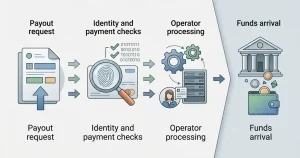
The first withdrawal can also take longer than later ones. A specialist review reports an additional twelve to twenty-four hours for document checks on first-time withdrawals. That reflects a review step, not necessarily a payment-provider delay. If identity or payment-ownership questions remain unresolved, the withdrawal may not move on the same schedule as a routine transaction.
I separate the stages when assessing a payout: operator review first, payment processing afterwards. “Fast” can describe only one of them. The distinction is easy to miss, and it matters.
What is the fastest withdrawal method?
PayPal is the fastest method listed, with withdrawals clearing in roughly 4–6 hours on weekdays and 8–10 hours from Friday to Sunday.
What is the context of GAMSTOP and self-exclusion?
Online operators regulated by the Gambling Commission in Great Britain must participate in GAMSTOP, the national self-exclusion service. Participation has been compulsory since 31 March 2020.
Is LeoVegas UK licensed?
Yes. The Gambling Commission lists LeoVegas Gaming PLC under account number 39198 and identifies leovegas.co.uk as its active UK-facing domain.
Is LeoVegas legitimate and safe to bet with?
LeoVegas is listed as a UK Gambling Commission-licensed operator, so it is subject to the regulator’s requirements, including GAMSTOP participation. A licence is an important regulatory safeguard, but it does not guarantee that every customer experience or outcome will be satisfactory.
Material created by the team Rolletto