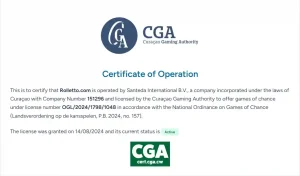
A licence does not by itself show how an operator handles account restrictions, gambling support or personal data.
What “Best” Can Mean When a Casino Is Outside UK Oversight
“Best” is a word that tends to compress several different decisions into one. A casino can look attractive because its games, promotions or payment options suit a particular player. That does not tell much about what happens when play stops being straightforward: when someone wants to restrict their account, asks for help with gambling, or disputes how personal information has been handled.
I have seen how a comparison can be shaped by what is easy to display. A welcome offer has a headline figure; a game lobby has recognisable titles; a payout claim fits neatly into a table. The quality of the protection behind the account is harder to reduce to a badge. It is also the part that matters most when a customer needs a process rather than another promotion.
A non UK regulated casino operates outside the UK Gambling Commission’s oversight. Its responsible-gambling requirements and data-protection rules may be less stringent than those applying to a UKGC-licensed operator. “May” matters here: the point is not that every non-UK site handles data carelessly or offers no player controls. It is that the safeguards cannot simply be assumed to match the UK framework because a site looks professional or describes itself as reputable.
When considering a Gibraltar casino licence in the UK context, check the licensing details that apply to each operator before deciding where to play. This reference card notes the payout-speed information available for the listed operators.
1. SlotoSport
Payout speed: 1-3 business days SlotoSport lists a payout speed of 1–3 business days.
2. EvoSpin
Payout speed: 1-3 business days EvoSpin lists a payout speed of 1–3 business days.
3. BeOnBet
Payout speed: 1-3 business days BeOnBet lists a payout speed of 1–3 business days.
4. Dieselwin
Payout speed: 1-3 business days Dieselwin lists a payout speed of 1–3 business days.
5. x3bet
Payout speed: 1-3 business days x3bet lists a payout speed of 1–3 business days.
6. Jetsetspins
Payout speed: 1-3 business days Jetsetspins lists a payout speed of 1–3 business days.
7. SpinFormula
Payout speed: 1-3 business days SpinFormula lists a payout speed of 1–3 business days.
8. NightLuck
Payout speed: 1-3 business days NightLuck lists a payout speed of 1–3 business days.
9. Zombillion
Payout speed: 1-3 business days Zombillion lists a payout speed of 1–3 business days.
10. Revery Play
Payout speed: 1-3 business days Revery Play lists a payout speed of 1–3 business days.
The same distinction applies to responsible-gambling tools. A site may offer account limits or ways to pause play, but a feature shown on a page is not automatically equivalent to a mandatory UK protection. Players using offshore casinos forfeit access to the UK’s mandatory responsible-gambling tools. Casinos not on GamStop are outside the UK Gambling Commission’s self-exclusion scheme, so a GamStop exclusion does not cover them. That gap can matter most when someone is trying to create distance from gambling, not when they are comparing game menus.
There is a practical difference between a control a company chooses to provide and a protection imposed across the UK-regulated market. A chosen control can depend on the operator’s own rules: how it is activated, what activity it covers and how it is enforced. The existence of a button is not the whole safeguard. The framework around it is what gives it weight.
Data protection is less visible still. A registration form asks for identifying information; later account checks may involve further documents. The handling of that information depends on the operator’s applicable rules and practices. If those protections are less stringent than UKGC standards, a player may have fewer assurances about how personal data is safeguarded. That is not proof of misuse. It is a reason not to treat a familiar-looking website or a polished privacy statement as equivalent to UK oversight.
The complaint route is another part of the “best” calculation that advertising tends to leave outside the frame. Players at offshore casinos lose access to the UK’s Financial Ombudsman Service. If a disagreement arises, the familiar UK route is not available simply because the customer lives in Britain or the site accepts British customers. The operator’s own support channel may still respond, but that is not the same thing as access to a UK public dispute-resolution service.
Casino Guides to Licensing, Access and Payments
This is why a list of the best online casinos associated with Gibraltar cannot be assessed on presentation alone. The word “best” might describe a preference for games or a particular account feature; it does not establish the strength of responsible-gambling protections, data handling or recourse when something goes wrong. A casino site can look orderly and still leave important safeguards outside the UK system.
I would separate product appeal from protection before drawing any conclusion. The first is visible during ordinary use. The second becomes visible under pressure, when an account needs limits, a person needs help stopping, or a complaint cannot be settled with customer support. Those are not minor qualifications to a ranking. They change what the ranking means.
The key question is not whether a site uses the word “safe” or whether it offers some controls. It is whether the protections relied on are part of the UK framework, and what is lost when they are not. “Best” may describe a preference. It cannot, by itself, describe the safety net.
Casino Sites in Gibraltar: The Licence Is Not the Whole Story
A casino website can carry a Gibraltar licence and still sit outside the UK Gambling Commission’s system. That distinction is easy to miss because the word “licensed” sounds complete: it identifies some form of regulatory permission, but not necessarily permission or oversight from the regulator responsible for Great Britain.
A casino can hold a Gibraltar licence but still operate outside the UK Gambling Commission’s system, meaning it is not subject to UKGC oversight.
In practical terms, a non-UK-regulated casino is an online gambling site that operates without UK Gambling Commission oversight. Its licence may come from Gibraltar, Malta, Curaçao or Anjouan. Those places are not interchangeable labels, and their names do not turn a foreign licence into a UKGC licence. The relevant question is not only whether a site names a regulator, but which regulator it is.
That is the point I keep separate when looking at Gibraltar casino sites. A licence from Gibraltar means the site is associated with that jurisdiction’s licensing framework; it does not mean the UK Gambling Commission supervises the casino. A location or licence reference can look reassuring on a page, but the words need to be read precisely. “Regulated” without saying by whom leaves out the part that matters most to a UK reader.
What the labels mean
“Gibraltar casino” is used loosely in ordinary descriptions. It may refer to a casino site whose licence is from Gibraltar, or to a business associated with that jurisdiction. Those descriptions are not the same as saying that the site is UK-regulated. The phrase “Gibraltar online casino sites” can therefore cover sites that are licensed outside the UK system, even if their pages are written for English-speaking customers.
The same distinction applies to online slots. A site offering casino games, including slots, does not become a UKGC-supervised service because its pages show a Gibraltar connection. “Gibraltar slot sites” describes a category by reference to a jurisdiction; it does not identify the regulator overseeing a customer’s play in Great Britain. The label is descriptive, not a substitute for checking the regulatory status.
Merkur Casino Online UK: Games, Sites and Safety
There is also a difference between a company and the website it operates. Search results may speak of “Gibraltar casino companies” or online casino companies in Gibraltar, but a company’s name, business address or association with a place does not by itself establish which licence covers a particular gambling service. The company and the regulator are separate parts of the picture.
I find it useful to read the claims in this order: first, identify the regulator named for the gambling service; then distinguish that authority from the UK Gambling Commission. That avoids treating a general statement such as “licensed casino” as though it answered every question about oversight. It does not.
Why the distinction matters
A Gibraltar licence should not be confused with UKGC oversight simply because Gibraltar is familiar as a gambling jurisdiction. Nor should the presence of a UK-facing website, British currency or familiar casino terminology be taken as evidence that the operator is regulated by the UK Gambling Commission. Those details describe how a site presents itself; they do not identify the authority overseeing it.
I would use “non-UK-regulated casino” for a site outside UK Gambling Commission oversight, whatever jurisdiction is named on its licensing material. “Gibraltar casino site” is narrower in one sense—it points to Gibraltar—but less precise in another, because it may not tell the reader whether the reference is to a licence, a business connection or some other association. The regulator’s identity is the clearer marker.
This distinction also prevents a common wording trap. A casino can be licensed somewhere and still be non-UK-regulated. The two statements do not conflict: the first describes a licence from another jurisdiction; the second describes the absence of UKGC oversight. In this market, “licensed” is not a complete description until the licensing authority is named.
Do
- Identify the specific regulator named for the service
- Distinguish the authority from the UK Gambling Commission
Don’t
- Treat “licensed casino” as a complete answer on oversight
- Assume a UK-facing website proves UKGC regulation
So Gibraltar is one of the jurisdictions associated with non-UK-regulated casino sites, alongside Malta, Curaçao and Anjouan. The jurisdiction name supplies context, not a ranking and not a UK regulatory status. A licence is one part of the description. The regulator behind it is the part that gives the label its meaning.
“Top” Sites and the Difference Between Regulatory Frameworks
A “top” label can make a casino list look like a comparison of quality. Often, it tells little about the standards behind the licence. When I assess a site, I separate its games and presentation from the rules its regulator requires: those are different questions, and a polished lobby cannot answer the second one.
That distinction matters when assessing casinos associated with Gibraltar. A search for the top online casinos in Gibraltar may bring together sites with different regulatory arrangements, but the word “Gibraltar” in a brand description or page heading is not evidence of what a regulator checks. Nor does a licence from one jurisdiction establish that another jurisdiction applies the same requirements. The framework has to be considered on its own terms.
Anjouan provides a concrete example. Its framework does not require operators to have random-number generator testing, audits or segregated player funds. These are separate safeguards, not interchangeable labels: testing concerns the game system, audits concern review of an operation, and segregation concerns the handling of customer money. Where the framework does not mandate them, a general claim that a site is “licensed” cannot be treated as confirmation that they are in place.
Casino Without a UK Licence: Rules and Risks
That is the point a simple ranking tends to hide. A casino may look well presented and still be operating under a framework with different requirements from another site. The comparison should therefore start with what the relevant authority requires, rather than with promotional language or the apparent size of a games catalogue. A licence is a regulatory status, not a shorthand for every safeguard a player might expect.
The Anjouan authority also does not handle, mediate or decide player complaints. That is a specific limit of its role. It should not be blurred with the question of whether an operator has a customer-service team: the existence of an internal contact channel is not the same as the regulator stepping in to resolve a dispute. Different functions. Different recourse.
I have seen how the word “top” does its work in marketing. It turns a collection of commercial claims into an implied verdict, while the underlying standards remain easy to miss. A meaningful comparison asks what the licence obliges the operator to do, what the authority itself oversees, and what it does not undertake. Those answers may be less eye-catching than a league table, but they say more about the framework.
This does not make every licence outside the UK identical. It means the opposite: each jurisdiction needs to be assessed separately, and the Anjouan example should not be used as a description of Gibraltar, Malta or Curaçao. The requirements named here are features of the Anjouan framework, not a universal offshore template. “Top” is not a regulatory category. The detail is.
Anjouan Framework
Does not require random-number generator testing, audits, or segregated player funds, and does not mediate complaints.
Gibraltar Framework
Associated with its own licensing framework, but does not automatically imply UK Gambling Commission supervision.
UKGC Framework
The mandatory system for operators serving the Great Britain market, providing specific protections and oversight.
Real-Money Play: Deposits, Withdrawals and the Terms Between Them
A deposit is only the first half of a payment arrangement. For real-money casino play, the route used to put funds into an account does not necessarily determine how a later withdrawal will be handled. The cashier may show several ways to pay, but the conditions attached to each method can differ, and the relevant terms are usually found in the payment rules rather than in the promotional wording around the games.
Non-UK-regulated casinos may accept credit cards, e-wallets, bank transfers and cryptocurrencies, sometimes using alternative payment processors. That variety can make the cashier look straightforward: select a method, enter the details and confirm. The less visible part is whether the same route is available for withdrawals, whether account verification affects processing, and whether the operator sets different conditions for different payment methods. A deposit option is not, by itself, a promise that withdrawals can be made through that same channel.
Crypto has a particular distinction in the UK context: cryptocurrency payments can bypass the UK ban on gambling funded by credit cards. That describes how the payment route works; it does not make the route equivalent to a card payment or settle what happens when a balance is cashed out. With any method, the cashier’s labels matter less than the withdrawal terms attached to the account.
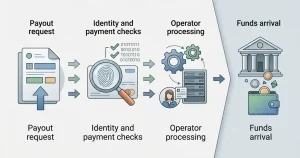
Timing claims need similar care. Published descriptions do not agree on a single standard: some say withdrawals at Casinos not on GamStop can arrive within 24 hours to 5 business days, depending on the payment method, while other accounts describe much longer waits. A stated processing estimate is not a guaranteed arrival time. Payment method, the operator’s handling and any conditions in the account terms can all affect the path from a withdrawal request to funds received.
USA Casinos for UK Players: Licensing and Risks
The distinction between processing and payout is useful. A casino may describe a request as being processed, but that does not necessarily mean the receiving bank or payment service has completed its part. Nor should a fast deposit be taken as evidence that a withdrawal will move at the same speed. Deposits and withdrawals are separate transactions, even when the same brand name appears on both sides of the cashier.
A further condition can change how a large balance is paid. A specialist review has reported that some non-UK-regulated casinos set daily, weekly or monthly withdrawal ceilings. Where such a cap applies, a sizeable win may have to be released in instalments rather than in one payment. This is a reported condition, not a rule that applies across the market; the operator’s own terms for the account are the operative detail.
That distinction changes the practical meaning of a win. The balance shown on screen and the amount available to withdraw immediately may not be the same thing when limits or method-specific rules apply. The important question is not simply whether the cashier accepts a deposit, but what conditions govern the return of funds: the eligible withdrawal route, the processing estimate and any cap on the amount paid at once.
Payment mechanics are rarely as simple as the first click suggests. Read the cash-out terms separately.
Gibraltar Casinos and UK Law: Where the Operator’s Duties Begin
A Gibraltar licence and permission to serve customers in Great Britain are different things. The legal question is not simply where a casino is based or which authority issued its licence. It is whether the operator is supplying gambling services to the British market. Under the Gambling Act 2005, that responsibility falls on the operator, not the individual player.
Legal Responsibility
Under the Gambling Act 2005, the responsibility to hold a UK Gambling Commission licence falls on the operator, not the player.
That distinction matters when a site presents itself as a Gibraltar online casino. A licence issued in Gibraltar does not, by itself, replace the UK Gambling Commission licence required for an operator serving customers in Great Britain. The operator’s location does not move the boundary of its UK-facing duties. From the industry side, this is the point that promotional language can blur: “licensed” may describe a real permission, but not necessarily permission to serve every market.
The Act focuses on the business conducting the gambling service. It does not make a player’s use of a site licensed abroad an offence simply because the site lacks UK authorisation. Nor does British law expressly bar citizens from using gambling services licensed in another country. Those points describe the position of the player; they do not convert an overseas licence into approval to operate in Great Britain.
There is a difference between a player not committing a criminal offence and a site being authorised to serve British customers. The first concerns individual liability. The second concerns the operator’s obligations. Confusing the two can make a Gibraltar casino online listing sound more reassuring than it is. A statement about the player’s legal exposure says nothing, on its own, about whether the operator has the required UK permission.
I have seen this distinction get lost in the wording around “available to UK players”. Availability is not the same as authorisation. A site may be reachable, and its terms may refer to a foreign licence, but neither fact settles whether it is permitted to supply gambling services into Great Britain. The relevant duty remains with the operator.
Online Casino No Registration in the UK: What It Means
The same logic applies to Gibraltar casinos online that use a Gibraltar-based business or describe themselves as holding a Gibraltar online gambling licence. The location and overseas licence may identify how the operator is organised; they do not answer the separate UK-market question. For Great Britain, an operator serving customers there needs the appropriate UK Gambling Commission licence, regardless of its base.
So the legal distinction is narrow but important. British players who use an unlicensed gambling site do not commit a criminal offence under UK law. That does not mean the site is authorised to serve them, or that its overseas permission amounts to UK approval. Player liability and operator authorisation are separate questions. Keep them separate.
What a Casino Licence Does—and What It Does Not Guarantee
A licence tells a player which regulatory framework an operator claims to work under. It is not, by itself, a complete description of how complaints are handled or what happens when a player wants to stop gambling. In practice, those details sit in the framework’s rules and the operator’s own procedures.
That distinction matters when terms such as “licensed” appear in casino marketing. A Gibraltar casino licence and an Anjouan casino licence refer to different jurisdictions; conditions attached to one should not be assumed to apply to the other. The phrase “online casino with Gibraltar licence” does not, on its own, explain the complaint route or establish what support tools are available. Those are separate questions from the licence label.
Anjouan provides a concrete illustration of the limits a licence can have. Casinos operating under an Anjouan casino licence are not required to connect to GAMSTOP, the UK self-exclusion scheme. A person who has chosen self-exclusion through that service should not assume the restriction will carry across to an Anjouan-licensed site. The licence does not create that connection.
Self-Exclusion
Casinos operating under an Anjouan licence are not required to connect to GAMSTOP; a UK self-exclusion does not automatically apply to these sites.
The same distinction applies when a complaint arises. Anjouan’s framework does not require casinos to offer an independent dispute-resolution process comparable to the services approved for UK Gambling Commission-licensed operators. Nor does the Anjouan authority handle, mediate or decide player complaints. A licence may set standards for the operator, but that does not automatically provide an outside body able to review a disagreement between the operator and its customer.
There is still a stated obligation: operators must respond to complaints within 30 calendar days under Anjouan’s framework. A response is not the same as an independent decision. It means the operator has to address the complaint; it does not mean an external adjudicator will determine whether the outcome is fair or require the operator to change it.
That difference is easy to miss in polished licensing language. A complaints email, an internal review and independent dispute resolution can sound like variations of the same service. They are not. One leaves the operator in control of the response; another gives a separate body a role in examining the dispute. The route matters.
From the other side of the counter, I learned not to read a licence badge as a summary of every safeguard. It identifies a regulatory home, while the practical protections depend on what that jurisdiction requires and what the operator actually provides. A Gibraltar licence should be assessed on its own terms, not by borrowing assumptions from Anjouan or from UKGC oversight. Labels travel easily. Remedies do not.
Why Online Casinos Choose Gibraltar and Other Licensing Jurisdictions
“Based in Gibraltar” describes a location, not a permission to serve every market. In the online casino industry, those two ideas are often compressed into a single line of promotional copy. From the operator’s side of the counter, that shorthand is convenient: it can make a business sound established while leaving the precise regulatory status unclear.
A casino may be associated with Gibraltar, but that fact alone does not establish which licence governs its gambling services or where it may lawfully offer them. The same distinction applies when a company describes itself as part of Gibraltar’s iGaming sector. Corporate location and market authorisation are separate questions.
Non-UK-regulated casinos are commonly licensed in jurisdictions including Gibraltar, Malta, Curaçao and Anjouan. The list identifies places where licences may be issued; it does not mean the frameworks are interchangeable, or that any of them is a UK Gambling Commission licence. A licence from one jurisdiction should be understood on its own terms.
The practical point is the market being served. Operators that provide gambling services to customers in Great Britain need a UK Gambling Commission licence, regardless of where the business is based. A Gibraltar address does not replace that requirement. Nor does a licence issued elsewhere become UK approval simply because the operator describes itself as an international or established casino.
This is why lists of “top” or “new” online casinos in Gibraltar can obscure more than they clarify. “Top” may refer to a publisher’s selection, while “new” may refer to a recent launch or a fresh appearance in a market. Neither label confirms the operator’s permission to serve British customers. The useful distinction is not old against new, or prominent against obscure; it is the difference between a stated location and the authorisation relevant to the customer’s market.
Regulatory Status
An operator’s headquarters or licensing jurisdiction is not a substitute for the specific authorisation required to serve a particular market.
I have seen how carefully those descriptions are framed. A jurisdiction name can sit prominently in a site footer, while the more important question—what customers and territory the licence covers—requires separate checking. The wording may be accurate and still leave the wrong impression. A location is not a passport.
For British customers, a non-UK-regulated casino operates outside the UKGC system. That does not make every overseas licence identical, and it does not establish that a particular site is authorised to offer gambling in Great Britain. Anyone considering an offshore service remains responsible for checking local laws and understanding the implications of using it. The operator’s headquarters, the name of its licensing jurisdiction and its permission to serve a market should not be treated as one thing. Short version: different questions.
How Offshore Casino Accounts Operate After a Withdrawal Request
A withdrawal request can change the pace of an account. While a balance remains available for play, the account may appear straightforward; once money is requested, the operator may review the account and ask for further verification. That is where the experience can stop feeling routine. The issue is not only how a payment is sent, but how long the operator takes to clear the request and what it requires before doing so.
Published accounts of withdrawal timing conflict. Some describe payments arriving within 24 hours to 5 business days; others say a non-UK-regulated casino can take as long as three or four weeks. Those are materially different expectations, not two ways of describing the same service. Where the longer delay occurs, there is no UK regulatory clock that forces the operator to complete the payout by a particular point.
The distinction matters when assessing an online casino associated with Gibraltar. A location in Gibraltar does not, by itself, tell a customer how an account review will be handled or how quickly a withdrawal will move. The account terms and the operator’s own verification process govern the practical steps, while a delay may leave the customer waiting without the UK enforcement route applying to that service.
Verification can also become more demanding after a request is made. A specialist review has reported cases in which operators asked for notarised documents or a video call before releasing funds. That should be read as a reported possibility, not a standard requirement across online casinos in Gibraltar. But it illustrates why a request for identity documents is not always the end of the process: additional steps may be introduced, and arranging them can add friction.
I would separate a slow payout from a payment method’s normal processing time. A request can be held for account checks before the transfer itself begins, so a fast payment channel does not necessarily mean a fast release. Nor does a stated processing estimate settle what happens if the operator asks for more evidence.
The practical risk is uncertainty after the request has been submitted: the account may remain under review, and the timing may stretch beyond the shorter estimates reported elsewhere. Keep records of the request and any messages, and read the withdrawal conditions before play rather than relying on a headline payout claim. The wording matters. The delay matters more.
Withdrawal Verification Requirements
Some non-UK-regulated casinos may require notarised documents or a video call before releasing funds, which can add significant friction to the process.
New Casino Offers: Read the Wagering Terms Before the Headline
A welcome offer is a set of conditions attached to a headline figure, not money that can simply be collected. For a casino newly appearing in Gibraltar-related listings, the “new” label says nothing about how much play is required before bonus funds or winnings become withdrawable. The operative terms are the ones that define eligible games, the wagering base, expiry and any cap.
A specialist review reports that some offshore welcome bonuses carry wagering requirements of 35x or more. That is a reported offer condition, not a dependable market-wide rate; terms vary and can change. The multiplier alone is not enough to understand the obligation. A 40x requirement may be calculated against the bonus alone, the deposit and bonus together, or a combined bonus-and-free-spins award. Those bases produce different amounts of qualifying play from the same advertised multiplier.
This is where promotional wording does its work. “Up to” a headline bonus can draw attention to the maximum, while the terms establish what qualifies and how much play follows. I learned to look for the calculation base before treating a multiplier as meaningful. A large number beside “free” does not remove the conditions.
Free spins have their own accounting. A specialist review reports examples in which winnings from spins are subject to wagering of 30–50 times those winnings and a withdrawal cap of £5–£50. These are reported terms, not a promise that every offer uses them. The cap can matter even after a player meets the wagering condition: the amount eligible to leave may still be limited. The headline and the cashable amount are not the same thing.
Expiry matters too, but the same specialist-review material describes particular packages rather than a universal rule. The offer terms need to be read for when spins or bonus funds stop being available, which games count towards wagering, and whether a cap applies to winnings. A free-spin count without those details is an incomplete description.
Curacao Casino Licence in the UK: What It Means
I used to read the promotional panel first. That was the wrong order. The headline sells the offer; the terms define it. A new Gibraltar-facing casino may present familiar bonus language, but only the actual conditions show whether the offer suits the way a player intends to play. No shortcut here.
When a Casino Is “Regulated” but Player Funds May Still Be Exposed
“Regulated” can sound like a promise that deposits are held apart from the operator’s own money. It is not a promise that follows automatically from a casino holding a licence. In the case of an Anjouan casino licence, player funds are not guaranteed to be segregated.
That distinction matters most if the operator fails. A player with money still on the account may then be an unsecured creditor, rather than someone whose balance is protected in a separate pool. The practical point is stark: a displayed account balance is not the same as cash held in trust for the customer.
I have seen the word “regulated” do a lot of work in casino copy. It signals that an authority has issued permission under its framework; it does not, by itself, explain what happens to customer balances if the business becomes insolvent. Those are different questions. Fund segregation is one of the details that must be established separately, not inferred from the presence of a licence badge.
This is also why descriptions such as “Gibraltar regulated online casinos” can leave an important gap if they focus only on location or regulatory status. A Gibraltar connection alone does not answer how a particular operator treats player money. Nor should the position under an Anjouan casino licence be casually applied to every other jurisdiction. The relevant point here is narrower: Anjouan licensing does not guarantee that balances are ring-fenced.
For anyone assessing a casino’s claims, the useful distinction is between permission to operate under a framework and protection of funds in an insolvency. The first does not establish the second. “Regulated” may describe oversight, while the customer’s position on failure remains exposed.
That is the uncomfortable detail. A balance can exist on screen, yet still rank as an ordinary claim against a failed operator. The word “regulated” cannot settle that question.
What payment methods work best at non-UK-regulated casino sites?
Offshore casinos may accept credit cards, e-wallets, bank transfers and cryptocurrencies, sometimes through alternative processors. Some also let players pay via a mobile-phone bill or prepaid balance; check the casino’s cashier for the methods it accepts.
Are gaming sites not on GamStop permitted for UK players?
UK law does not explicitly prohibit British players from using gambling services licensed abroad, and players do not commit a criminal offence by gambling on an unlicensed site. However, operators serving customers in Great Britain need a UK Gambling Commission licence, and sites outside GamStop are not covered by its self-exclusion scheme.
Is it legal for a UK player to gamble at an Anjouan-licensed casino?
A UK player does not commit a criminal offence under UK law by gambling on an unlicensed site. But an Anjouan licence does not authorise an operator to serve the UK market; operators serving Great Britain need a UK Gambling Commission licence.
What happens if I have a dispute with an Anjouan-licensed casino as a UK player?
The Anjouan authority does not handle or adjudicate player complaints, and these casinos do not provide an independent dispute-resolution route comparable to UK-approved ADR. The operator must respond to complaints within 30 calendar days, but UK players cannot rely on the UK Financial Ombudsman Service for disputes with offshore casinos.
Material created by the team Rolletto