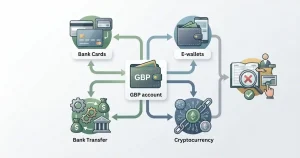
A site’s branding does not establish its regulatory status; the operator’s licensing system determines whether GamStop applies.
What “outside GamStop” means in practice
GamStop is a self-exclusion service linked to online gambling operators regulated by the UK Gambling Commission (UKGC). When someone registers with GamStop, the restriction applies at participating gambling establishments. For online casinos, participation is not an optional feature that an operator can advertise or leave out: UKGC-licensed operators are required to take part.
That makes “outside GamStop” a description of the operator’s relationship with the scheme, not a type of game, account or bonus. A casino is not outside GamStop because it has a particular website design or payment method. The relevant distinction is whether it falls within the UKGC system to which GamStop applies.
I find it useful to separate two ideas that are often blurred in casino descriptions. One is whether a site participates in GamStop. The other is whether it is a British online casino in the regulatory sense. Those phrases are not interchangeable. A site’s wording, branding or apparent familiarity does not establish its regulatory status. The practical question is which system governs the operator.
For UK online casinos covered by the UKGC, GamStop participation is part of the operating framework. The service is intended to prevent a registered person from gambling with those participating establishments during the chosen exclusion. It is not a setting that a player can switch off at one casino while leaving it active at another UKGC-regulated casino. The participating operators are connected through the scheme’s exclusion process.
This is why descriptions such as “not on GamStop” need careful reading. They indicate that the site is not included in the UKGC-regulated group covered by the service; they do not mean that GamStop has failed to recognise a UKGC operator or that a participating British casino can simply decide not to comply. A site may use the phrase as a selling point, but the phrase itself tells little about the operator beyond its relationship to GamStop.
The distinction also helps explain why lists labelled “UK online casino sites” can be confusing. Some use “UK” to refer to the audience they are trying to attract; others use it to describe the regulatory framework under which they operate. Those are different claims. In this context, a British online casino means more than a site that accepts British visitors or presents information in pounds. GamStop’s scope follows UKGC jurisdiction, not the wording on a homepage.
Non-GamStop European Casinos: UK Rules Explained
Nor does the phrase “outside GamStop” describe a second version of GamStop. It does not mean that an operator has a separate account-level arrangement with the service, or that a registered person can ask GamStop to include a particular non-participating site. The scheme’s reach is defined by the establishments it covers. For online casinos within the UKGC system, participation is required; beyond that system, the label signals that the GamStop exclusion does not operate there.
In practice, the phrase should therefore be read as a boundary marker, not a quality rating. “Outside” does not say that a casino is better, safer, more flexible or equivalent to a UKGC-regulated operator. It says only that the site is not part of the group of casinos to which GamStop applies. Treating that narrow meaning as an endorsement is a mistake. A label is not a safeguard.
The wording can also obscure what GamStop actually does. It restricts registered users from gambling at covered establishments. It does not, by itself, describe every account rule at a casino, assess a site’s customer service, or certify that a site is suitable for a particular person. Those are separate matters. The point here is narrower: UKGC-licensed online operators must participate, and GamStop applies to casinos operating within the Commission’s jurisdiction.
That is the basic test I use when interpreting the phrase. I do not infer participation from a casino’s name, its marketing or the fact that it appears in a list of British casino online options. I look at the regulatory relationship the description is claiming. If “not on GamStop” is being used to attract attention, the underlying meaning remains plain: it is outside the scheme’s participating UKGC-regulated group.
The distinction is simple. Its consequences are not.
Licensing, jurisdiction and the limits of UK protection
A casino’s licence tells more than a logo on its footer. It identifies the regulator responsible for the operator and, just as importantly, the boundary of that regulator’s authority. When a site is licensed outside the UK, its rules and oversight come from that jurisdiction, not from the UK Gambling Commission (UKGC). That is why a foreign licence does not bring the protections of a UK licence with it.
A foreign licence does not bring the protections of a UK licence with it, and a licence issued abroad does not authorise an operator to serve the British market.
Some operators hold licences in places such as Malta, Gibraltar or Curacao. Those jurisdictions are not interchangeable, and the name of a regulator alone does not establish what safeguards apply in practice. Nor does a licence issued abroad authorise an operator to serve the British market. Remote gambling operators offering services to people in Great Britain must hold the relevant UKGC licence, wherever the business is based. A site can therefore have a licence elsewhere and still lack the UK authorisation required to operate legally for British customers.
That distinction is easy to blur in casino marketing. A phrase such as “internationally licensed” may sound like a general seal of approval; in practice, it describes a licence issued under another jurisdiction’s rules. It is not a substitute for a UKGC licence. I have seen how one reassuring badge can do the work of a paragraph in an advert. It cannot do the work of the regulator.
The operator’s position and the player’s position
The legal boundary applies differently to the business and the customer. An operator offering real-money gambling to people in Great Britain without a UKGC licence is acting unlawfully. A player using a site that is not on GamStop does not, on that basis, commit a criminal offence. Those statements can both be true, but neither makes an unlicensed service a UK casino site in the regulatory sense.
Non-Gamban Casinos in the UK: What Exclusion Means
For a consumer, the practical consequence is a different protection framework. A UKGC-licensed operator is subject to UK requirements; an operator regulated elsewhere is not brought under those requirements merely because it accepts a British customer. The protections associated with a UKGC licence should not be assumed to apply. This is the central difference—not whether the site looks polished, accepts familiar payment methods or uses the word “trusted”.
Where a dispute arises, the regulator overseeing the operator may be based abroad, and the process will be governed by that jurisdiction’s arrangements. A British customer should not assume that UK complaints routes or remedies will operate in the same way. Players using casinos not on GamStop may also lack access to UK-based support services through the operator. The distinction is consequential. Not cosmetic.
A foreign licence may still impose obligations on its licensee, but the existence of some oversight is not proof that its protections match those of the UKGC. I would treat any comparison as a question of specific rules and enforceable remedies, not branding. “Licensed” is a description; it is not a complete account of what happens when an account is restricted, a withdrawal is disputed or a complaint is unresolved.
What a licence check can establish
A sensible check starts with the regulator, not a banner on the casino’s own pages. The operator’s stated licence details should be checked against the regulator’s official records, including whether the licence belongs to the same business named on the site. Even a genuine foreign licence answers only a limited question: whether that regulator lists the operator under its authority. It does not establish that the operator is permitted to serve Great Britain.
Do
- Check the operator’s licence against official regulator records
- Verify if the licence belongs to the business named on the site
- Distinguish between the operator’s location and the licensing authority
Don’t
- Assume a “secure” label establishes UKGC oversight
- Rely on “British slots” as proof of regulatory status
- Collapse customer location and licensing jurisdiction into one label
This is where descriptions such as “British slots” or “British casino bonuses” can mislead by implication. The games or promotions may be presented to British customers, but that does not turn the operator into a British-regulated business. The location of the customer, the location of the company and the location of the licensing authority are separate facts. They should not be collapsed into one reassuring label.
The same care applies when a site describes itself as “secure”. That word may refer to a technical feature, but it does not establish UKGC oversight, access to UK protections or the quality of dispute resolution. A polished interface is not jurisdiction. A familiar game is not jurisdiction. A licence claim needs to be understood for what it covers—and what it does not.
The useful distinction is therefore straightforward: a non-UK licence belongs to a separate regulatory system, while British-facing remote gambling requires UKGC authorisation. Playing at a site outside GamStop is not itself a criminal offence for the customer, but that does not make an operator’s unauthorised British-facing service lawful or give the customer UKGC protections. Both sides of the boundary matter.
What a “best” site claim can—and cannot—tell you
When reviewing casinos not on Gamstop, check the available operator information carefully and consider whether gambling is right for you. The payout speed shown here is one practical detail to keep in view.
1. SlotoSport
Payout speed: 1-3 business days SlotoSport lists a payout speed of 1–3 business days.
2. EvoSpin
Payout speed: 1-3 business days EvoSpin lists a payout speed of 1–3 business days.
3. BeOnBet
Payout speed: 1-3 business days BeOnBet lists a payout speed of 1–3 business days.
4. Dieselwin
Payout speed: 1-3 business days Dieselwin lists a payout speed of 1–3 business days.
5. x3bet
Payout speed: 1-3 business days x3bet lists a payout speed of 1–3 business days.
6. Jetsetspins
Payout speed: 1-3 business days Jetsetspins lists a payout speed of 1–3 business days.
7. SpinFormula
Payout speed: 1-3 business days SpinFormula lists a payout speed of 1–3 business days.
8. NightLuck
Payout speed: 1-3 business days NightLuck lists a payout speed of 1–3 business days.
9. Zombillion
Payout speed: 1-3 business days Zombillion lists a payout speed of 1–3 business days.
10. Revery Play
Payout speed: 1-3 business days Revery Play lists a payout speed of 1–3 business days.
The word “best” looks like a verdict. In casino marketing, it is often just a label attached to a comparison whose rules are not stated. A page may discuss bonuses, games, apps, payouts or rewards, but those features do not by themselves establish that an operator is suitable, legitimate or equivalent to a British-licensed casino. The ranking is only as useful as the criteria behind it.
I have seen how easily a comparison can blur two separate questions: what a site offers, and whether it is authorised to serve customers in Great Britain. A polished review, a broad game catalogue or an attractive offer cannot answer the second question. Nor does a review’s use of “British” prove that the casino holds a UK Gambling Commission licence. The label describes the page’s intended audience; it is not a regulatory status.
There is an important legal distinction. A UK player’s use of a casino that is not on GamStop is not itself a criminal offence. But an operator offering online gambling services to UK residents without a valid UKGC licence is acting illegally. Those statements are not contradictory: one concerns the player, the other the operator. A “best” list that treats them as interchangeable leaves out the point that matters most.
That is why comparisons between casinos not on GamStop and UKGC-licensed operators need a clear boundary. A list may assess what its author considers desirable, but it cannot turn an unlicensed operator into a licensed one. It also cannot establish that protections or recourse are the same. Calling a site “legit” without explaining what that means is not a useful finding. It may refer to a functioning website, a claimed licence, or simply the writer’s opinion. Those are different things.
The same caution applies to reviews of casino bonuses, games, apps, payouts, rewards and jackpots. They concern different features, and none is a substitute for checking the operator’s status. A review can describe an offer; it cannot make the underlying service lawful for the operator to provide to customers in Great Britain. A fast-sounding payout claim or a large-sounding jackpot does not resolve that question either. Advertising language is not evidence.
A UK player’s use of a casino not on GamStop is not a criminal offence, but an operator offering services to UK residents without a valid UKGC licence is acting illegally.
A comparison is more informative when it states what is being compared and does not imply more than it can show. If “best” means a personal preference, say so. If it means a review score, explain what the score measures. If the page includes casinos outside the UKGC system, it should make that distinction plain rather than placing every name under a single, reassuring heading. Otherwise, the ranking creates a false equivalence.
There is also a difference between a review and an endorsement. A review can examine claims and describe limitations; an endorsement nudges the reader towards a choice. For casinos not on GamStop, that distinction matters particularly where a reader may be seeking an alternative during a self-exclusion. A ranked position is not evidence that the site is an appropriate substitute, and presenting one as such would make the list do more than its wording admits.
My own rule for reading these pages is straightforward: separate the sales language from the legal question. “Best British casino” may sound like a quality judgment, but the phrase does not establish that a casino is British-licensed. “Best casino apps” says nothing about an operator’s authority to serve Great Britain. A collection of positive reviews does not alter the legal position.
A list can still help organise information. It can point out what its writer chose to assess. It cannot settle the difference between a player’s position and an operator’s obligations, or make a non-UKGC service comparable to one operating under a UKGC licence. The label is not the licence.
Non-GamStop casinos in 2026: the important distinction
“Not on GamStop” describes a gap in the exclusion system, not a special category of British casino. The distinction is about which regulator’s rules apply and whether an operator is connected to the UK self-exclusion service. A site may be reachable from Britain without being a UK-licensed casino.
GamStop works through participating operators. UK Gambling Commission-licensed online casinos must take part, so a registered exclusion is applied across those services. A casino operating outside the Commission’s regulatory reach does not have that same obligation. It does not share customer exclusion data with GamStop or carry out GamStop’s blocking measures.
That is the practical meaning behind searches for British casinos not on GamStop. The phrase can make an overseas service sound like a British operator with one feature switched off. It is not. The operator is outside the UK system, and its relationship with GamStop is different because it is not governed by the UKGC requirements that bind participating casinos.
The distinction is easy to miss in promotional language. “Unrestricted” may sound like a product advantage; in this context, it can mean that an existing GamStop exclusion will not be recognised by that operator. That is not an extension of the UK system or a way to amend an exclusion. It is a separate service with no shared exclusion mechanism.
There is also an important difference between being able to open a site and an operator being entitled to serve the British market. UK residents may be able to reach online casinos based overseas, but operators offering remote gambling to people in Great Britain must hold a UK Gambling Commission licence. A foreign site’s accessibility does not establish that it is authorised to provide gambling services in Britain. The legal position is not made simpler by a familiar-looking name, English-language pages or a British-facing promotion.
Regulatory Gap
Casinos operating outside the UKGC framework may lack mandatory responsible-gambling tools and do not recognise GamStop exclusions.
For players, using a casino without a UKGC licence is not itself a criminal offence. But the absence of GamStop integration sits alongside the absence of the protections attached to a UKGC licence. These services operate outside the UK regulatory framework and may lack mandatory responsible-gambling tools. Any limits, reminders or self-exclusion options they offer are not a substitute for GamStop’s shared exclusion system.
I have seen how the difference gets blurred in marketing: the headline discusses access, while the regulatory boundary is left in small print. The headline is not the whole arrangement. A site’s own controls, if offered, apply according to that operator’s processes; they do not notify GamStop or block a person across UK-licensed casinos. Nor does a foreign gambling regulator provide the same UKGC oversight simply because it has issued a licence.
That distinction affects support as well. A person using a non-GamStop casino should not assume that UK-based gambling support services can intervene in the operator’s account or enforce the site’s own decisions. The casino sits outside that domestic regulatory route. Its policies and the protections available depend on the service and jurisdiction involved, not on GamStop’s registration.
So “British” in a search phrase should not be read as proof that a casino is British-licensed. And “not on GamStop” should not be read as a technical alternative within GamStop. It signals that the operator does not participate in the scheme. Different system. Different safeguards.
Casino Sites Not on GamStop: UK Rules and Checks
UK self-exclusion periods and what they mean
GamStop self-exclusion is not a cooling-off setting that can be switched off when circumstances change. The available periods are six months, one year or five years. The choice sets the length of the restriction, and the service does not allow an active exclusion to be shortened or cancelled before that period has run its course.
That fixed term matters because registration is intended to put distance between a person and online gambling, not to create a temporary obstacle that can be removed on impulse. From the operator side, the instruction is straightforward: participating UK-licensed casinos must apply the exclusion for the period selected. A later change of mind does not give an individual casino discretion to restore access.
There is no early-release route. Asking a casino to reopen an account, contacting customer support or deciding that the original choice no longer feels necessary does not bring the end date forward. The restriction remains in place until the selected period ends.
Choosing a period
The three options represent materially different commitments. Six months is the shortest listed period; one year extends the exclusion; five years is the longest. The important point is not to treat the shortest option as a trial or the longest as a setting that can be revised later. Each is a fixed term once registered.
I have seen how a promotion can make a decision feel immediate: a bonus, a new game or a familiar brand is presented as a reason to act now. Self-exclusion works in the opposite direction. It removes participating online casinos from that decision environment for the selected period. No quick reversal. That is the mechanism.
The period is therefore a choice about how long the barrier should remain, not a prediction about how someone will feel later. A person may find the restriction useful throughout the term, or may regret selecting it. Neither reaction changes the rule on cancellation.
Available GamStop exclusion periods
Registration options are fixed at six months, one year, or five years. These terms cannot be shortened or cancelled early once selected.
What happens while it is active
During an active GamStop exclusion, accounts at participating casinos are not meant to be available for gambling. A casino cannot make an exception because a customer asks, and a shorter period cannot be negotiated with an individual operator. The end of the selected term is the point at which the restriction ceases under the chosen period; it is not something customer service can bring forward.
This distinction is worth keeping clear when comparing casino offers or reading reviews. Bonuses, live tables and payment options have no bearing on the exclusion’s end date. They do not create an exception, and an account-level request does not override the registration.
The practical decision comes before registration: select a period with the understanding that it will stay in force until it expires. Once chosen, the term is fixed.
Ways people try to get around GamStop—and why not to treat them as solutions
When a self-exclusion blocks access to participating gambling establishments, some people look for a route around the restriction. The routes reported include registering with a gambling service that does not cooperate with GamStop, using another person’s details, or attempting to conceal location through tools such as a VPN, proxy or the TOR browser. A report on neconnected.co.uk describes the use of other people’s personal data and anonymising tools in this context; that should not be read as evidence that these methods are dependable or widely available.
The distinction matters. A service that does not participate in GamStop will not apply that exclusion through the scheme. It operates outside the UK Gambling Commission’s framework, so protections and responsible-gambling measures required of UK-licensed operators may not apply. Any limits or reminders offered by an overseas service are not a substitute for the protections attached to a UKGC licence. Access to UK-based support services may also be unavailable through that operator.
A workaround can create new problems without resolving the reason the exclusion was set. Using someone else’s identity risks account and payment disputes, while attempts to disguise location can conflict with an operator’s terms and lead to access problems. I have seen the practical difference between an account that appears open and one that can actually be used without complications. Not the same thing.
Crypto is sometimes mentioned alongside non-participating services. It is not a protective shortcut: cryptocurrency transfers are irreversible, and a mistake in a wallet address can mean the funds are permanently lost. A transaction may move value; it does not restore the protections or self-exclusion controls that were sought in the first place.
There are also routes that are not technical workarounds. Gambling at a land-based venue is distinct from using an online account covered by GamStop. The other option is to wait until the chosen exclusion period has ended and then unsubscribe in accordance with the service’s process. An active self-exclusion cannot be shortened or cancelled early.
That distinction is important because bypass attempts can turn a pause into a search for access. A new account, a different device or a different payment method does not change the underlying position. Nor does finding an app or a promotion make an unprotected service equivalent to a UK-licensed one. The headline offer is beside the point.
From the operator side, registration and access are not proof that a service is suitable for someone who chose to exclude themselves. A route may appear to work at first and still leave identity, funds or support unresolved later. I would not treat any of these attempts as a solution. The restriction has a purpose.
Attempts to bypass GamStop using VPNs, proxies, or other people’s personal data can lead to account disputes and access problems.
Free spins and bonus wagering: read the conditions, not the headline
A “free spin” describes how a spin is credited, not what its winnings are worth or whether they can be withdrawn. In my experience, the headline gets attention; the terms decide what happens next. A British casino free spins bonus may attach winnings to a bonus balance, where wagering rules apply before cash-out.
The key figure is the wagering requirement: how much qualifying play must be recorded before bonus winnings become eligible for withdrawal. A specialist review source puts the industry range at around 30x to 40x and describes requirements above 50x as generally predatory. Those are review-based benchmarks, not a guarantee that every offer in that range is fair. The calculation base matters too: the terms should make clear whether the multiple applies to the bonus, the deposit, or another stated amount.
Game weighting changes the calculation. Slots may count fully, while table games can contribute less or be excluded altogether. That means a player who switches from slots to blackjack may make little progress against the requirement, even while spending real money. “All games count” is not a useful description unless the weighting for each category is clear.
The fine print can also set a maximum bet while wagering is active, a deadline for completing the requirement, or a cap on withdrawals from bonus winnings. Each condition changes the practical value of the offer. A cap can limit what is paid out; a deadline can leave unfinished wagering at risk of expiry; a bet limit can affect whether a spin or round qualifies. These are terms to read together, not as isolated clauses.
Free British slots may sound like a route to unrestricted play, but a promotional spin is still governed by the offer’s rules. The same applies to free spins attached to British-themed slots: the theme says nothing about contribution rates, eligible games or withdrawal conditions. “Free” is a price label, not a complete description.
There is another distinction behind offers at casinos not on GamStop. They operate outside the UK Gambling Commission’s framework and may lack responsible-gambling tools that UK rules require. Any limits or reminders they provide are not necessarily imposed by the UK regulator. A bonus does not offset that difference in protection.
I have found that the most useful comparison is not the advertised spin count. It is the route from credit to withdrawable funds: which games qualify, how play is counted, what restrictions apply, and what happens if a condition is missed. If those mechanics are buried or unclear, the headline is doing more work than the offer.
New casinos and slots: what the available facts do not establish
A site described as a new British casino, or a slot promoted as newly released, is not evidence that its launch, ownership, licence or safeguards have been independently confirmed. I have seen how easily a fresh-looking brand or product label can do the work of a proper explanation. “New” is a sales description, not a safety standard.
That matters particularly for Casinos not on GamStop. A specialist review may report that a particular non-UK service provides deposit or loss limits, session controls, reality checks, reminders or a self-exclusion option. Such features may be offered voluntarily; they are not automatically required by the UK framework. Their presence on a page does not, by itself, establish how they operate, whether limits can be changed, or what happens when a player asks for help.
Features such as deposit limits or session controls in non-UK services may be offered voluntarily and are not automatically required by the UK regulatory framework.
The same restraint applies to new slots. A launch claim does not establish the game’s provider, rules, return, or whether the advertised version is available on the stated site. Without those details, a list of “new” titles would create an impression of verification that the label alone cannot support.
I would separate three things: a product being announced, its details being independently checked, and the protections attached to the service offering it. They are not interchangeable. An appealing interface and a recent launch date say little about whether a site has meaningful controls or how consistently it applies them.
For anyone affected by gambling, unfamiliar branding should not be treated as a reason to resume play during self-exclusion. New is not proof.
Reviews, verification and getting winnings out
A useful casino review treats withdrawal terms as part of the service, not a footnote to the games or rewards. It should distinguish the operator’s processing time from the time a payment takes to reach an account. A specialist review describes e-wallet withdrawals as generally faster than card payments, while noting that casino processing can take up to 24 hours. That is not a guarantee of the total wait: payment providers and account checks also matter.
KYC verification is another point to examine before depositing. Specialist reviews advise completing identity checks early, since leaving them until a withdrawal can create delays. Verification does not remove the need to meet the casino’s terms, and a review should not imply that an account is ready to pay out merely because a deposit was accepted.
Crypto can look attractive when a specialist review reports fast withdrawals. The value received can still change with the cryptocurrency’s market price between payment and conversion. Transfers are irreversible; a mistake in the wallet address can mean the funds are permanently lost. Fast is not the same as predictable.
Non-GamStop Curacao Casino Sites: UK Licensing
There is a wider distinction behind any assessment of British casino reviews and payouts. Casinos not on GamStop operate outside the UK Gambling Commission’s framework and may not provide its mandatory protections or access to UK-based support services. A review of payment methods cannot establish equivalent consumer protection, nor does a favourable withdrawal report settle the operator’s legal position. In Britain, remote operators serving customers must hold the relevant UKGC licence.
I have learned to read payout claims as process descriptions, not promises. The method, account checks and operator’s handling all shape the result. Details matter.
No-deposit bonuses: the conditions still matter
A no-deposit bonus sounds like money available without putting funds in first. In practice, it is an offer governed by its terms, and any winnings may remain conditional. The headline describes how the bonus is claimed, not what can ultimately be withdrawn.
Specialist casino reviews report that bonus rules can set a maximum bet while wagering conditions are active, a deadline for completing them, and a cap on withdrawals from bonus winnings. Those details change the practical value of an offer. A withdrawal cap, for instance, can limit what is payable even when the balance appears higher. Read the full terms before treating a displayed amount as cash.
The same care applies to game restrictions and wagering rules: the offer’s wording determines what counts and what does not. If a condition is unclear, the headline cannot resolve it. Fine print decides.
For British players, a no-deposit offer does not change the regulatory status of the casino. Remote operators offering gambling to customers in Great Britain must hold a UK Gambling Commission licence. Casinos not on GamStop sit outside that framework and may lack mandatory responsible-gambling tools and access to UK-based support services. That is a material difference, not a bonus feature.
I have seen “free” do a lot of work in promotional copy. It can mean no initial payment is needed; it does not mean winnings are unrestricted, or that the operator’s terms disappear. The offer and the cash are not the same thing.
How can players get around Gamstop?
GamStop does not cover gambling establishments outside its participating UKGC-licensed group, but using them bypasses the exclusion rather than ending it. A registered person should keep the exclusion in place and wait until the selected period ends.
Can I reverse a self-exclusion from GamStop early?
No. A GamStop exclusion cannot be shortened or cancelled before the period you selected has ended.
What gambling sites are not on Gamstop?
Sites outside the UKGC-regulated group, including some casinos licensed in jurisdictions such as Malta, Gibraltar or Curacao, are not covered by GamStop. A foreign licence is not a UKGC licence, and operators serving people in Great Britain must hold the relevant UKGC licence.
Is it safe to play at non-Gamstop gambling sites?
A non-GamStop site does not provide the consumer protections associated with a UKGC licence. Some may offer limits or self-exclusion voluntarily, but these are not guaranteed by the UKGC framework.
What exactly does Gamstop block?
GamStop restricts registered users from gambling at establishments covered by the scheme, including UKGC-licensed online casinos. It does not apply to casinos outside the UKGC’s jurisdiction.
What is Gamstop?
GamStop is a self-exclusion service for people in the UK that restricts registered users from gambling with participating UKGC-licensed operators.
How does Gamstop work?
A person registers with GamStop and chooses an exclusion period of six months, one year or five years. Participating UKGC-licensed operators must apply the restriction for that period.
Material created by the team Rolletto