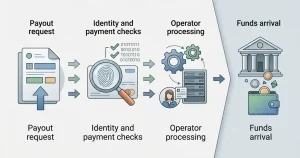


A document-free sign-up does not mean an account is verified or that identity checks will never be required.
What “Without ID” Means at a UK Online Casino
“Without ID” sounds like a single feature, but it can describe several different things. In my experience, the phrase is most useful when treated as shorthand for a particular step being absent or delayed—not as a clear description of the whole account process.
At one end, a casino may let someone register without uploading a document at that moment. The form might ask for personal details, while identity documents are not part of the initial sign-up screen. That is a claim about the opening stage only. It does not, by itself, mean the account has been verified or that documents will never be needed.
“Without photo ID” can mean something narrower still. It may refer to not being asked to send a photograph of a passport or driving licence during registration. A site may instead check details through another process, or request documents later. The phrase does not establish which method applies, or whether the account can remain without an identity check.
Megaways Slots at UK Online Casinos: What to Check
Then there is “no ID check”. That wording may be used for a smooth sign-up where no document request appears immediately. It can also be read as a promise that the operator will not verify identity at all. Those are materially different claims. The first describes what happens on the screen at one point; the second describes an account with no identity verification throughout its use.
For a UK-licensed casino, the second meaning is not a realistic description. Licensed operators must verify players’ identities, and the process commonly involves a photo ID and proof of address. So an online casino without ID in the broad sense—no identity verification at any stage—is not the same thing as a low-friction registration. The label does not change that distinction.
A useful way to parse the phrase is to separate three questions: whether documents are requested during registration, whether the operator checks identity by some other means, and whether documents could be requested later. A “no upload” claim answers only the first question, if it answers even that. It says nothing conclusive about the other two.
Penny Slots in the UK: Stakes, Spins and RTP
This is why terms such as “instant play” or “quick registration” can be confused with anonymity. They describe the customer-facing process, not necessarily what is happening behind it. Some checks may be carried out without a document upload appearing at sign-up. A short form is not proof that an account is anonymous. Different thing.
The same distinction applies to a casino without photo ID. If a person has no passport or driving licence available, that is a practical document issue; it does not mean the operator has waived the need to establish who holds the account. Whether another document or verification route is accepted depends on the operator’s process. The phrase alone does not settle it.
“Online casino with no ID check” is therefore ambiguous unless “check” is defined. It might mean no visible document request before registration is complete. It might mean no manual review at that point. Or it might suggest that identity will never be verified. Those meanings should not be treated as interchangeable. In particular, a sign-up that appears to work without document upload does not prove that the account is exempt from verification.
American Roulette Online in the UK: Odds and Tables
The wording around “online casino without ID UK 2026” can also blur the difference between a UK-licensed casino and an offshore site. A casino serving the British market legally must hold a current UK Gambling Commission licence. Offshore operators sit outside that UKGC system; their use of “no ID” does not make them UK-licensed or place them under the same rules. A site’s own description is not a substitute for its regulatory status.
I would read “without ID” as a statement about a stage or a document, unless it explicitly claims more. “No documents at registration” is narrower than “no identity check”; “no photo ID” is narrower than “no verification”; and none of those phrases, on its own, means that an account can remain unverified indefinitely. The practical difference matters because the language often compresses several separate processes into one attractive label.
There is no single technical meaning attached to “no ID casino”. It is a marketing phrase, not a defined account type. A clear description should say what is not requested, when that applies, and whether another form of verification is involved. Without those details, “without ID” tells little beyond the fact that the wording has been chosen to suggest less friction.
Attention: A sign-up process that does not require an immediate document upload is not proof that an account is anonymous or exempt from identity verification.
Why UK Casinos Still Need to Verify Players
A site can make registration feel light without removing the checks that apply to a licensed operator. That distinction matters. A player may not be asked to upload a document at the first screen, but that does not mean a UK casino can accept an account as permanently anonymous.
Age is the first hard boundary. Operators must establish that a customer is at least 18 before allowing a deposit into a gambling account. A form that accepts a date of birth is not, by itself, proof that the age check has been completed. The account’s path to real-money gambling depends on the operator having checked eligibility, not simply on the customer having entered details.
Identity checks sit alongside that age requirement. Every UKGC-licensed operator must verify its players’ identities, and the process commonly involves asking for photo identification and proof of address. A casino may be able to complete part of its checks without putting an upload request in front of a new customer immediately. But a smoother sign-up is not an exemption from the operator’s obligation.
That is why “no ID needed” can be a misleading description of the arrangement. In practice, it may describe what the registration screen asks for, rather than what the operator must establish before or during a customer relationship. The distinction is easy to miss because the first experience is visible to the player; the compliance work behind it is not.
Online Casino Tournaments in the UK: Entry and Prizes
The legal framework explains why the distinction exists. In England, Scotland and Wales, operators offering real-money gambling must hold a licence from the UK Gambling Commission. Remote gambling businesses selling into the British market need the relevant UKGC licence even if the business is based elsewhere. Online gambling is legal in the UK only through licensed and regulated sites, and a legal online casino serving UK players needs a current operating licence.
The Gambling Act 2005 provides the main framework for gambling in England, Wales and Scotland; Northern Ireland is outside that Act’s coverage. The wording matters, but it does not turn an offshore casino into a UK-licensed one. Offshore operators sit outside the UKGC system. A site’s accessibility from the UK is not the same thing as permission to serve the British market.
Verification is also part of a wider regulatory system, not a cosmetic step attached to a welcome offer. UKGC licence requirements cover standards on fairness, anti-money laundering and responsible gambling. The operator has to know who is using the account in order to apply its controls and meet its obligations. A site that promises real-money play while implying that identity checks can be avoided entirely is describing something incompatible with the duties of a UKGC licensee.
This is where the language of “instant play” can blur the issue. It describes a customer journey, not a legal status. The account may be created quickly; the operator still has to satisfy itself about age and identity. A brief sign-up is not the same as an unchecked account. Nor does a casino become compliant simply by leaving a document request until later.
Check Licence
If a gambling site serving the UK market does not prominently display its UKGC licence number in the footer, close the tab immediately.
I have seen why this distinction gets lost in marketing: fewer steps can make a product look easier to use, while verification is an interruption most operators would rather not foreground. But the operational obligation does not disappear because a page emphasises speed. The customer-facing promise and the back-office requirement are different things.
The practical starting point is the licence. A gambling site serving the UK market must prominently display its UKGC licence number in the footer; if it is absent, close the tab immediately. The number should also be checked against the UK Gambling Commission’s public register before depositing. A licence is not a promise that every interaction will be frictionless. It is evidence that the operator is within the local regulatory system, where age and identity verification are requirements rather than optional features.
“Without ID” is not a route around those requirements. It may describe a lighter first impression, but a UK-licensed casino still has to verify its players. The obligation remains.
Reading “No ID Check” Claims on Casino Sites
The wording on a casino landing page is rarely the whole offer. “No ID check” may appear beside a sign-up button, while the account terms reserve the operator’s right to request documents. I learned to read those statements as sales copy, not as a complete description of the account conditions. The operative detail is often elsewhere: in registration rules, withdrawal terms, bonus conditions or a general verification clause.
Start with the exact promise. “No documents needed to register” is narrower than “no verification”, and neither necessarily says what happens when account details cannot be confirmed or a later transaction is reviewed. A claim about signing up should not be stretched into a claim about every stage of using the account. The distinction matters.
Online Bingo in the UK: Formats and Slots
Match the headline to the terms
Terms and conditions are not fine print in the harmless sense. They define the operator’s discretion and the situations in which an account may be restricted while checks are made. Look for wording about identity documents, account reviews, payment ownership, withdrawals and the consequences of not supplying requested information. The point is not to predict exactly when a request will arrive; it is to see whether the headline leaves room for one.
Broad phrases such as “play without paperwork” can be especially slippery. They may describe a shorter registration process, not a lasting exemption. If the terms say the operator can request evidence at its discretion, the headline does not cancel that condition. Nor does a support agent’s casual reassurance override published account rules. Keep the promise and the qualification side by side.
I have seen how a short headline can do more work than the terms beneath it. It attracts attention; the clauses preserve flexibility. Read both.
Treat bonus wording separately
A no-deposit offer describes how a promotion is funded, not what identity conditions apply to an account. “No deposit” is not the same as “no documents”, and a bonus being available before a payment does not establish that the account can remain unchecked. The promotion’s own terms may also set eligibility conditions, restrictions on use, or conditions for converting bonus-related winnings into withdrawable funds.
For a no-ID casino no-deposit bonus claim, check whether the page states that documents are not needed only to claim the offer, or makes a broader promise about the account. Then compare that language with the general terms. If the promotion page is silent while the account rules allow checks, silence is not a waiver. A bonus can be genuine and still carry conditions that the headline does not spell out.
Do
- Compare the headline promise with the general account terms
- Verify the UKGC licence number on the public register
- Identify the precise stage the claim covers
Don’t
- Treat promotional headlines as complete account conditions
- Assume a no-deposit bonus means no identity checks
- Rely on a support agent’s casual reassurance over published rules
The same discipline applies to “no photo ID”. That phrase may be intended to distinguish photo-document upload from other forms of review, but the wording alone cannot establish what alternatives the operator accepts or whether it may ask for evidence later. Avoid reading more into it than the page actually says.
Check who is making the claim
A review page, advert or search result may describe a casino in terms the operator itself does not use. Follow the claim through to the operator’s own registration and terms pages. Check that the site displays its UKGC licence number prominently in the footer, then verify that number on the UK Gambling Commission’s public register before depositing. If the number is not prominently displayed in the footer, close the tab immediately.
A polished page is not proof that its wording is accurate, and a licence badge alone is not the same as checking the register. Where the operator’s own documents qualify a third-party claim, the qualification is the useful part. Keep a copy of the relevant wording if a promotion or account condition later becomes disputed.
My practical test is simple: identify the precise stage the claim covers, locate the terms that qualify it, and check that the claim comes from the operator rather than an intermediary. “No check” without a clear scope is marketing shorthand. That is all.
What “Best” Can Mean When No Casino Can Promise No Checks
When looking for an online casino without ID checks in the UK, review the available information carefully and confirm any verification requirements directly with the operator. This list highlights the payout-speed detail provided for each option.
1. SlotoSport
Payout speed: 1-3 business days SlotoSport lists a payout speed of 1–3 business days.
2. EvoSpin
Payout speed: 1-3 business days EvoSpin lists a payout speed of 1–3 business days.
3. BeOnBet
Payout speed: 1-3 business days BeOnBet lists a payout speed of 1–3 business days.
4. Dieselwin
Payout speed: 1-3 business days Dieselwin lists a payout speed of 1–3 business days.
5. x3bet
Payout speed: 1-3 business days x3bet lists a payout speed of 1–3 business days.
6. Jetsetspins
Payout speed: 1-3 business days Jetsetspins lists a payout speed of 1–3 business days.
7. SpinFormula
Payout speed: 1-3 business days SpinFormula lists a payout speed of 1–3 business days.
8. NightLuck
Payout speed: 1-3 business days NightLuck lists a payout speed of 1–3 business days.
9. Zombillion
Payout speed: 1-3 business days Zombillion lists a payout speed of 1–3 business days.
10. Revery Play
Payout speed: 1-3 business days Revery Play lists a payout speed of 1–3 business days.
A ranking built around the “best” no-ID casino starts with a problem: the label cannot establish that an account will never be checked. In the UK, every legal online casino serving players must hold a current UK Gambling Commission licence, and licensed operators must verify identity. A site cannot turn that obligation into a permanent exemption by describing itself as anonymous or document-free.
I would not rank casinos by a promise that their licensing duties make impossible. Without reliable, current evidence about an operator’s process, a best-of list would present an advertising claim as a tested feature. Even a smooth registration says little about whether an account can remain unverified. Different experiences are not proof of different rules.
A more meaningful comparison is narrower: how clearly an operator explains its account requirements, how its terms describe verification, and whether its public information matches the service being offered. That is a comparison of transparency and process, not a guarantee of anonymity. The wording matters. “Best” can mean easiest to understand; it cannot mean exempt from checks.
The licence is a basic test, not a badge to overlook. A gambling site should prominently display its UKGC licence number in the footer. If it does not, close the tab immediately. The number should also be checked against the UK Gambling Commission’s public register before depositing. That does not prove every account interaction will be frictionless. It establishes whether the operator has the required standing to serve the British market.
“No deposit” describes an offer or a way to start playing; it does not describe identity status. A bonus may be available without an initial payment, but that says nothing about whether the operator can verify the account. “No deposit, no ID” combines two separate claims. The first concerns funding. The second suggests an exemption the phrase itself cannot provide.
In the UK, online gambling is legal for adults aged 18 and over only at licensed and regulated sites.
Bitcoin wording has the same limit. A payment method does not establish that a casino is anonymous, nor does it remove the operator’s UK licensing obligations. The word “bitcoin” can describe how a site presents payments; it is not evidence that a UK player can use the service without checks. Different question.
When I assess a “best no-ID” claim, I separate the measurable service from the sales label. Is the licence number visible? Are the account terms clear? Does the operator explain what may be required, rather than relying on an absolute promise? Those points can be assessed from published information. A claim that no checks will ever occur cannot be safely inferred from a headline, a bonus, or a payment option.
That leaves no honest shortlist of casinos ranked by guaranteed anonymity. A comparison may assess clarity and usability, but it should not award a top position for avoiding a requirement that applies to licensed operators. The distinction is less catchy. It is more useful.
Verification Can Come Later, but It Is Not Gone
A casino account can appear usable before a request for identity documents arrives. Registration may be accepted, the site may open its games, and an account may show activity without any document upload at that point. That sequence can look like “no ID verification”. In practice, it describes when a check appears, not whether the operator can require one.
I have seen the distinction matter most when the first stages of an account feel routine. A player signs up, browses the lobby or joins a game, and assumes that the absence of an immediate request is evidence of a permanent exemption. It is not. UKGC-licensed operators have to verify players’ identities, and checks can be handled in stages. An early green light is not a final decision about the account.
Jackpot King Slots at UK Casinos: What to Check
Live games do not change that. A live casino without an ID check may simply be a site that has not asked for documents yet, or an account that has passed an initial screening without a document upload. The live dealer, the game session and the visible balance do not cancel identity checks. The same applies to other casino activity: using an account is not proof that verification has been completed.
The practical distinction is between access and confirmed identity. A site may allow some activity while its checks are pending or before a further check becomes necessary. If the operator later needs evidence to confirm account details, the earlier access does not bind it to leave the account unverified. That is the part advertising tends to leave in the background.
This is why “online casino with no ID verification” can describe a moment rather than a lasting feature. The account may have no document request at sign-up, yet still be subject to checks later. Those are not contradictory statements. One concerns the timing of a request; the other concerns the operator’s responsibility across the account.
I would treat a working account as a working account, not as proof that identity requirements have disappeared. Before depositing, the site’s UKGC licence number should be visible in its footer and checked against the Commission’s public register. If the number is not prominently displayed, close the tab. A smooth first session is not a substitute for that basic check.
Timing vs Obligation
Activity can start before a document request, but this does not turn a licensed casino into an unverified one.
The useful conclusion is narrow: activity can start before a document request, but it cannot turn a licensed casino into an unverified one. Timing changes. The obligation remains.
What a “No ID Casino UK” Search Can Realistically Find
In my experience, “no ID” is often shorthand for a sign-up that feels less cumbersome, not a different kind of legal account. A form may ask for basic details and let registration proceed without an immediate document upload. That can be a lower-friction start. It does not establish that the account is unverified or will remain so.
For a UK player, the distinction matters because a legal online casino serving the market must hold a current UK Gambling Commission licence, and licensed operators must verify players’ identities. They must also confirm age before allowing a deposit. An account that opens quickly is not evidence that these requirements have disappeared. It may only describe what happens at the first screen.
The realistic result of looking for a no-ID casino is therefore a mix of different things: sites using “no ID” to describe their registration process, operators that may not ask for documents immediately, and services outside the UKGC system. Those are not interchangeable options. Offshore casinos do not hold a UKGC licence; a site presented as a UK casino should not be treated as legal simply because it accepts a UK customer or uses familiar branding.
NoLimit City Slots at UK Online Casinos
I would separate the convenience claim from the account status. Fewer fields at registration can reduce friction. A skipped upload at that point says nothing conclusive about whether the operator has completed the required checks. Nor does a smooth first visit turn an unverified account into a verified one. Different stages of an account can look seamless from the outside while the operator’s compliance obligations remain in place.
The basic legitimacy check is less glamorous than the phrase “no ID casino”: a UKGC licence number should be prominently displayed in the site footer and should match the Commission’s public register. If the number is not displayed there, close the tab. If the details do not match the register, the site has not earned trust through a quick sign-up.
This is not a promise of anonymity. It is a way to distinguish a streamlined front end from a casino that can lawfully serve UK players. In the UK, online gambling is legal for adults aged 18 and over only at licensed and regulated sites. “No ID” may describe an early experience; it cannot by itself establish the operator’s status or the account’s verification position.
That is the useful boundary. A low-friction registration can be real. A lawful UK casino account with no identity verification at all is not the same thing. The wording may blur them. The licence does not.
Crypto, Real-Money Play and the Same Verification Rules
Crypto can change how money moves; it does not change what a UK-licensed casino is required to do. A Bitcoin deposit, or another digital-asset payment, is still connected to an account used for gambling. The payment method is not a substitute for identity checks, and it does not turn a real-money casino account into an anonymous one.
UK Licensing and Crypto
A remote operator offering gambling to people in Great Britain must hold the relevant UK Gambling Commission licence, regardless of where the business is based; using cryptocurrency does not change this regulatory status.
I have seen payment options presented as if the technology itself removes the usual checks. That wording confuses two separate things: how funds are transferred and who is permitted to use the account. The operator remains responsible for its customers. Every UKGC-licensed operator must verify identity, and age must be checked before a customer can deposit. The route taken by the money does not cancel either obligation.
The same applies to the game selected. Slots, table games and other casino products do not create separate verification rules. A game may have its own rules for wagers and play, but choosing it does not make the account exempt from checks. “No ID games” is therefore not a meaningful category for licensed UK real-money play. The game is not the account.
There is also a legal distinction behind claims about crypto casinos. A remote operator offering gambling to people in Great Britain must hold the relevant UK Gambling Commission licence, wherever the business is based. Offshore sites may be accessible, but they sit outside the UKGC system and are not licensed to serve the British market. A crypto payment does not change that status or provide the protections of a UK-licensed operator.
In practical terms, a payment screen that accepts cryptocurrency says something about the payment channel, not about whether a customer’s identity will be checked. Nor does a game lobby establish that an account can remain unverified. Those are different questions, often blurred together in promotional copy.
The phrase “real money, no ID” leaves out the part that matters: a licensed operator cannot promise that identity checks do not apply. Cryptocurrency does not create an exception, and neither does a particular casino game. The technology may be different. The obligation is not.
Big Jackpot Slots at Online Casinos: What to Verify
Why “No Verification” Is Not a Reliable Promise
A casino can make registration feel simple without making a lasting commitment about identity checks. I have seen those two ideas blurred together: no document request at the outset becomes “no verification” in the headline, although the first describes a sign-up experience and the second sounds like a permanent exemption.
That is a much bigger claim. Every UKGC-licensed operator must verify players’ identity, and the process usually involves photo ID and proof of address. A casino cannot turn an initial lack of paperwork into a promise that its obligations have disappeared. The account may be open; the underlying requirement remains.
This is why “no verification” is not a dependable description of the whole relationship with a casino. It may reflect a particular registration route, an early stage of account use, or simply a phrase chosen to attract attention. None of those meanings establishes that an account will never be checked. The wording can sound absolute while the service itself remains conditional.
I used to read short promotional labels as if they described a fixed feature. That was the mistake. In practice, a label has to be judged against what the operator is required to do, not just what happened during one sign-up. A player who completes registration without uploading documents has evidence only of that experience—not of permanent anonymity or a right to remain unverified.
There is also a difference between a promise and an outcome. A smooth account opening does not bind an operator to ignore later identity questions, and a site’s use of “no ID” does not cancel the rules applying to its UKGC licence. The headline may describe the path into the account. It cannot guarantee every step that follows.
Verification Realities
- No document request at registration is not a permanent exemption from verification
- Licensed operators must verify identity and age to meet regulatory duties
- Promotional labels often describe the sign-up experience rather than the legal status
- The UKGC licence is the only reliable evidence of regulatory standing
For anyone comparing online casinos without ID verification in the UK, the sensible reading is narrow: some services may not ask for documents during initial registration. That is not the same as a casino agreeing never to verify its customers. An absolute assurance should be treated cautiously, especially where it is presented as a feature that overrides the operator’s responsibilities.
The distinction is plain, even when the wording is not. No request yet. No exemption.
Withdrawals Are Where Verification Claims Can Be Tested
A withdrawal request is often the point at which a “no ID” claim meets the operator’s actual account controls. A deposit may have gone through and the balance may be visible, but neither establishes that the account is ready for money to be paid out. The operator still has to verify the player’s identity; a request for documents during a cash-out is not proof that the earlier activity removed that requirement.
Mega Moolah casinos in the UK: what is verified
I have seen the wording do a lot of work here. “No ID withdrawal” can sound like a promise that winnings will be sent without checks. In practice, a site may mean that it does not require documents at registration, or that no document request appeared before the withdrawal was submitted. Those are narrower claims. They do not settle what happens when the payment is reviewed.
If documents are requested, the withdrawal may remain pending while the operator checks them. UKGC-licensed operators typically use photo ID and proof of address as part of identity verification. The details and handling process should be set out in the site’s terms or account guidance; a broad banner is not a substitute for those conditions. A mismatch between account details and submitted documents can also leave the operator needing clarification.
This is why an easy deposit is a poor test of a cash-out promise. Payment acceptance and release of a withdrawal are separate decisions. I would treat a claim of guaranteed payment without ID as especially doubtful if its terms reserve the right to request verification or hold a transaction for review. Read the withdrawal conditions before relying on the wording.
Divine Fortune UK Casinos: What the Game Facts Show
The licence matters too. A gambling site serving the UK must hold a current UKGC operating licence, and its licence number should be displayed prominently in the footer. If it is absent, close the tab. Verify the number on the UKGC public register before depositing.
No document request yet is not the same as no check at payout. Be precise.
Free Spins Do Not Remove Identity Checks
A free-spin offer describes a promotion, not the verification status of the account receiving it. The distinction matters because the advertising tends to put the reward first: spins appear to be available at registration, while the conditions governing the account sit elsewhere. Neither the offer nor the act of crediting spins establishes that a player can remain unidentified.
I have seen promotional language treated as if it were a shortcut through the operator’s normal controls. It is not. A UKGC-licensed casino must verify players’ identity, and it must establish age before allowing a deposit. A promotion cannot override those requirements. Where verification is needed, the operator may ask for documents such as photo ID and proof of address, even if the initial offer was presented as simple to claim.
Red Tiger Slots at UK Online Casinos: What to Check
There is also a difference between receiving spins and being able to use every feature of an account without restriction. The promotional balance may be displayed or attached to an account while checks are still outstanding. That does not turn the account into an anonymous one, and it does not make a “no ID casino free spins” claim a reliable description of what happens throughout the customer relationship.
The practical reading is straightforward: treat free spins as a promotional benefit with its own terms, not as evidence that identity checks have been waived. The wording may tell how the offer is triggered or what applies to any winnings. It cannot promise that the operator will never verify the account.
That is the dividing line. Spins are a promotion. Identity checks are separate.
How long do online casino withdrawals take in the UK?
E-wallet withdrawals typically process within 24 hours once the operator releases the funds.
Are online bingo winnings taxable in the UK?
No, recreational players in the UK do not pay tax on online bingo winnings.
How do I know if an online bingo site is safe?
Check that it holds a current UK Gambling Commission licence. UKGC requirements include standards for fairness, anti-money laundering and responsible gambling.
When is the best time to play for smaller prize pools?
Try playing outside the 7pm–11pm peak period, when bingo rooms schedule their largest prize pools.
What is the minimum age to play bingo legally in the UK?
You must be at least 18 to gamble legally in the UK.
Material created by the team Rolletto