

A practical guide to spin costs, slot outcomes, deposits, bonus conditions and the steps between a win and a withdrawal.
What a Real-Money Slot Spin Actually Costs
A slot’s advertised stake is not always the amount that will be deducted for one spin. The total depends on the stake selected and, where the game offers them, the paylines activated. Those are separate controls, and the cost is the amount charged for the complete spin—not simply the figure shown beside one control.
I have seen players focus on the stake selector and miss the line setting beside it. A game may let them choose how much to stake on each active line, or display a total stake that already reflects the selected lines. The labels differ. What matters is whether the amount on screen is the price of the whole spin or only one part of its calculation. The game’s own stake display should make that distinction clear before play begins.
When a slot charges a stake across active paylines, adding lines increases the total cost of a spin. The reason is straightforward: more lines are included in the play, so more of the stake is committed to that round. Reducing the selected stake can lower the total, while activating additional lines can raise it again. A player comparing two spins therefore needs to compare the final stake shown for each one, not just the amount selected per line.
This is where “low stakes” can become an imprecise label. A small amount assigned to each line does not necessarily mean the whole spin costs that amount. If several lines are active, the combined charge can be higher. Conversely, a larger stake on fewer lines may produce a different total. The game’s interface determines how these settings are presented, so the arithmetic should be read from the full-spin total rather than guessed from a single number.
Paylines also affect the chance of matching a winning combination. Activating more lines gives more possible lines on which a combination can land, but it raises the cost of every spin. That is a trade-off, not a discount or a promise of profit. A greater chance of a line-based win does not mean that a particular spin will return more than it costs, or that the extra stake will be recovered. The cost is known before the spin; the value of any result is not.
Online Casino Tournaments in the UK: Entry and Prizes
For real-cash slot play in Great Britain, the maximum stake for a single online slot spin is £5 for a player aged 25 or over. For players aged 18 to 24, the ceiling is £2 per spin. These are limits on the stake for the spin, not guidance on what a person should spend. A game’s stake controls still determine the amount chosen below the applicable ceiling, and active paylines can affect the total charged. The displayed total must remain within the relevant limit.
In practice, I would separate three figures when looking at a slot: the stake assigned to a line, the number of lines in play, and the total stake for the spin. Not every game presents all three in the same way. Some make the total prominent; others require a closer look at the controls. A change to either the stake or the line selection can alter the cost, so the total should be checked again after changing settings.
That distinction matters when setting a budget. A deposit limit concerns the amount placed into an account; it does not tell a player how quickly that balance may be used. The pace depends partly on the cost of each spin and how often spins are started. Before a first deposit, a financial limit can help define the amount set aside for play. It does not change the slot’s price calculation, but it makes the cost easier to judge against a fixed amount.
“More lines” is often presented as a fuller way to play. Mechanically, it means paying for more possible winning lines on each spin. It is not a free enhancement. A player who wants to keep the cost steady may need to reduce another setting when activating extra lines, if the game allows that combination. If the controls do not make the resulting total clear, the spin should not be treated as having the lower price.
Do
- Identify the total amount charged for the entire spin
- Confirm how selected paylines affect the total
- Compare the final stake with the applicable ceiling and budget
Don’t
- Assume a small per-line stake means a low total cost
- Guess the total price from a single number on screen
- Treat activating more lines as a free enhancement
The practical check is simple: identify the amount charged for the entire spin, confirm how the selected paylines affect it, and compare that total with the applicable stake ceiling and personal budget. A stake is the price of entering one round. The chance of a winning combination is a different part of the game. Keeping those two ideas separate is the clearest way to understand what each spin costs.
How Slot Outcomes Work—and Why a Win Cannot Be Promised
A slot session can feel as though it is building towards something. A near miss appears, then another; a feature has not appeared for a while; a run of wins seems to suggest the game is in a generous mood. I have seen how easily those impressions turn into a plan: keep going because a result feels due. They do not make the next outcome more likely.
Previous spins have no bearing on future outcomes. A new spin does not remember whether the last one paid, how long the game has been running or what happened to another player. A sequence that looks meaningful to a person is not evidence that the next result must follow it. The machine owes no correction. No result is due.
That is why a strategy cannot guarantee a win, or make a particular combination arrive. Changing the timing of a spin, repeating a pattern or stopping and restarting may change the way a session feels, but it does not alter the next outcome. A system based on chasing losses has the same limitation: it can change how long someone continues, not turn a past result into a promise about the next one.
Online Bingo in the UK: Formats and Slots
The distinction matters when people search for ways to win real cash on slot machines. A tactic can organise play, but it cannot predict a result. “Due” is a comforting word. It is not a feature of the game.
Every player has an equal chance of winning; that does not mean that each spin is a win, or that anyone can know when a win will happen. Nor does a player’s earlier run give them a special claim on the next outcome. The result remains uncertain, even when a screen displays a sequence that looks like a pattern.
The same reasoning applies to free-play versions and promotional spins. A virtual balance or a no-deposit offer may make a session feel different, but it does not make outcomes predictable. Where an offer has separate conditions, those govern what can happen to any resulting balance; they do not provide a method for forecasting the spin. “Free” describes the way play is offered, not a promise of a cash prize.
I learned to separate what a player can control from what they cannot. A player can decide whether to continue, but cannot choose the result of an individual spin by applying a system. That remains true whether the aim is a small win or a large one, and whether a game is played on a phone or elsewhere. A winning moment can happen. It cannot be scheduled.
The practical conclusion is plain: no strategy makes a slot win certain, and a previous result cannot tell anyone what comes next. A pattern may look persuasive. It still proves nothing.
Slot Outcomes
No strategy can guarantee a win, and previous results have no bearing on future outcomes.
Real-Cash Casino Games in the UK: The Rules Behind the Market
The phrase “UK rules” can conceal an important distinction. Great Britain and Northern Ireland do not share one identical licensing framework for online gambling. The UK Gambling Commission regulates commercial gambling in Great Britain, including remote casino games offered to consumers there. Northern Ireland has a separate regulatory framework, so the Great Britain licensing position should not be treated as applying there in the same way.
For England, Scotland and Wales, the central point is that an operator offering remote gambling to consumers in the market must hold the relevant Gambling Commission licence. This applies whether the casino is accessed through a website or another remote service, and the location of the equipment used to provide it does not change the licensing requirement. A business cannot avoid the Great Britain framework simply by placing its key equipment elsewhere.
That is the regulatory boundary behind online casino games for real cash in Great Britain. The Commission is the sole regulator for commercial gambling there. Its role is not limited to casinos, but online casinos fall within the gambling activity it regulates. The framework concerns the businesses providing the service and the people who perform regulated roles within them.
The licence structure has two levels. Operating licences are issued to businesses, while personal licences apply to individuals operating in Great Britain. These are not interchangeable: a personal licence does not replace the business’s operating licence, and a company’s operating licence is not a personal authorisation for every individual involved. The distinction reflects who is responsible for providing gambling and who is responsible for carrying out particular operating functions.
I have seen licensing reduced in marketing to a badge beside a casino name. That misses the point. The licence attaches to a business and its authorised gambling activity; it is not a general stamp on every game or a promise about a particular outcome. For real-cash casino play in Great Britain, the relevant question is whether the service is being offered under the required Commission authorisation.
Licensing Distinction
The UK Gambling Commission regulates commercial gambling in Great Britain (England, Scotland, and Wales), while Northern Ireland operates under a separate regulatory framework.
The territorial boundary matters as much as the licence type. The Commission’s authority over remote gambling offered to Great Britain consumers applies regardless of where the operator or its equipment is based. Northern Ireland sits under a separate framework, so a statement about the Commission’s Great Britain remit cannot simply be extended across the whole United Kingdom without qualification.
This is why “UK casino” can be imprecise when used as a regulatory description. In everyday language it may refer to the whole country; in licensing terms, the rules described here concern Great Britain. The distinction does not alter the basic point for that market: a company providing commercial remote casino gambling must be licensed by the relevant regulator, and the Commission is the regulator for Great Britain.
A licence is the framework, not the game itself. It identifies the regulatory system under which the operator provides real-cash casino games; it does not make every claim in an advertisement self-explanatory. Separate terms still govern how a particular service works. Different question.
What “Best” Means When Comparing Real-Cash Casinos
Choosing an online casino for real-money play in the UK involves considering how quickly withdrawals are processed. This list gives a concise reference point for readers weighing their options.
1. SlotoSport
Payout speed: 1-3 business days SlotoSport lists a payout speed of 1–3 business days.
2. EvoSpin
Payout speed: 1-3 business days EvoSpin lists a payout speed of 1–3 business days.
3. BeOnBet
Payout speed: 1-3 business days BeOnBet lists a payout speed of 1–3 business days.
4. Dieselwin
Payout speed: 1-3 business days Dieselwin lists a payout speed of 1–3 business days.
5. x3bet
Payout speed: 1-3 business days x3bet lists a payout speed of 1–3 business days.
6. Jetsetspins
Payout speed: 1-3 business days Jetsetspins lists a payout speed of 1–3 business days.
7. SpinFormula
Payout speed: 1-3 business days SpinFormula lists a payout speed of 1–3 business days.
8. NightLuck
Payout speed: 1-3 business days NightLuck lists a payout speed of 1–3 business days.
9. Zombillion
Payout speed: 1-3 business days Zombillion lists a payout speed of 1–3 business days.
10. Revery Play
Payout speed: 1-3 business days Revery Play lists a payout speed of 1–3 business days.
“Best” is a judgement, not a licence category. In my experience, comparisons become useful only when the same questions are applied to each site: whether it can lawfully serve the relevant part of the UK, what rules govern play, and whether those rules fit the way someone intends to use the casino. A polished layout or a large games lobby cannot answer those questions on its own.
For customers in England, Scotland and Wales, the first distinction is licensing. Operators offering real-money gambling to people in Great Britain must hold the relevant UK Gambling Commission licence. The Commission’s requirement applies to remote operators serving Great Britain, wherever their equipment is based. A company address abroad does not, by itself, remove that obligation.
I would treat the regulator’s register as the practical starting point, rather than relying on a logo, a footer statement or a claim in promotional copy. A licence check is not a quality score: it establishes the operator’s recorded status and the scope shown in the register, not that every feature will suit every player. Details can also change, so an old screenshot or an undated review is weaker evidence than a current entry.
The boundary matters. Northern Ireland has a separate regulatory framework, and the Great Britain licensing position does not apply there in the same way. A comparison that treats “UK” as one uniform licensing area risks giving people in different jurisdictions the wrong impression. The location of the customer is part of the question, not a footnote.
Divine Fortune UK Casinos: What the Game Facts Show
Once status is clear, the terms are where apparently similar casinos can differ. I look for rules that affect what a balance represents and what actions count towards any offer attached to play. Relevant details can include wagering requirements, maximum-bet rules while an offer is active, game contribution percentages and any maximum cashout limit. These are not decorative clauses. Each can change the practical value of a promotion, and a headline figure tells little without its conditions.
For instance, a game may be available in the lobby but contribute differently towards a promotion’s wagering requirement from another game. That is a condition of the offer, not evidence that one game is inherently better. Likewise, a maximum-bet rule may apply only while bonus funds are in use. I keep these distinctions separate when comparing terms; otherwise, a site can look more generous on the surface than its usable offer turns out to be. Read the wording, not just the banner.
The same discipline applies to real-cash slot games. A broad selection may matter to someone who prefers slots, but a long catalogue alone does not establish that the casino is the best choice. The relevant comparison is whether the games and rules fit the intended type of play, alongside the licence and any terms that affect access to an offer. “Best slots” and “best casino” are not interchangeable claims.
I also avoid turning a comparison into a ranking without a stated basis. One person may care most about clear terms; another may prioritise a particular style of game. If the criteria are not disclosed, a numbered order can create false precision. I would rather identify the evidence behind a comparison than pretend that one operator is objectively best for everyone.
Comparing Casinos
- Confirm the licence for the relevant jurisdiction
- Check the regulator’s register for current status
- Review wagering requirements and maximum-bet rules
- Identify game contribution percentages and cashout limits
That is the useful standard: confirm the licence for the relevant jurisdiction, then compare the rules that materially govern play. A casino’s advertising describes its offer. Its licence entry and terms show the framework around it. No ranking needed.
What “Pays Real Cash” Means After a Casino Win
A win appearing on screen is not the same thing as money arriving in a bank account. In the casino’s account, the result may first appear as a change to the displayed balance. That tells the player what the game has credited; it does not, by itself, show that the amount is ready to leave the account or that a payment has been completed.
I learned to separate those stages because the word “cash” can make them sound like one event. It is not. A game result is recorded, the account balance is updated, a withdrawal may be requested, the operator processes that request, and the chosen payment service handles the transfer. Until the money reaches the destination account, the on-screen figure remains an account balance rather than cash in hand.
That distinction matters for slots as much as for other casino games. A slot can credit a prize to an account, but the machine does not send funds directly to a bank. The casino account sits between the game and the payment method. So, when people look for online casino games that pay real cash, the meaningful question is not only whether a game can award a prize. It is whether the resulting funds can pass through the account and withdrawal process under the applicable conditions.
From game result to available balance
A game result may be credited while the amount is still subject to account conditions. The balance shown can therefore combine money with different statuses: funds that are available for play, funds that are restricted, or a withdrawal request that has not yet completed. The labels vary between account systems, so the number alone is not a reliable guide to what can be taken out.
I do not treat a displayed total as a promise of immediate payment. The practical test is whether the account identifies an amount as available to withdraw and whether the withdrawal request can be submitted. Even then, submission is not the same as completion. An operator may show a request as pending while it is being handled; the payment provider still has to deliver the transfer. Those are separate points in the chain.
The conditions attached to a particular win also matter. A balance can include promotional funds or winnings linked to an offer, and those may not be treated like an unrestricted cash balance. The rules can set requirements before a withdrawal is available, or restrict how much of a particular award can be withdrawn. In those cases, a displayed win is real as an account entry, but it does not automatically mean the full amount is ready to cash out.
The Payout Route
Step 1: Game Result
The game records the result and credits the prize to the casino account balance.
Step 2: Condition Check
The operator verifies if the funds are unrestricted or subject to promotional wagering requirements.
Step 3: Withdrawal Request
The player submits a request for the available balance via a supported payment method.
Step 4: Processing and Transfer
The operator approves the request and the payment service handles the transfer to the bank account.
This is where “pays real cash” becomes a claim about the whole route, not just the game. A casino game may award money, but the useful distinction is between a prize credited to the account and an amount that has cleared the applicable conditions and can be requested as a withdrawal. A successful request then needs to reach the selected payment method.
The withdrawal route
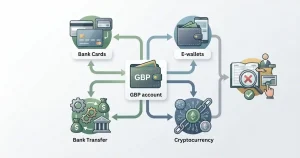
Payment method affects the final part of that route. A specialist payment-method review identifies PayPal, open banking services and debit cards connected to fast payout systems as among the quicker options. That is a comparison of methods, not a promise that every withdrawal using one will arrive immediately. The casino’s handling and the payment service’s own processing are distinct stages, and speed at one stage does not establish the timing of the other.
I keep that distinction clear when assessing claims about online casinos that pay real cash. “Fast” can describe a payment route without telling the reader when a particular request will be approved or received. “Instant” is stronger still, but a label cannot collapse account checks, operator processing and the receiving service into one guaranteed moment.
The destination matters too. A withdrawal method needs to be one the casino supports for withdrawals, not merely a way to put money into the account. The available options and any conditions are part of the account’s payment terms. If a payment method is unavailable for cashing out, its convenience for deposits says nothing about how winnings can be received.
European Roulette Online Casinos in the UK
Before play, operators must establish a customer’s identity and verify age before allowing deposits or gambling. That requirement is part of the account relationship, not a detail that turns a displayed win into a completed payment. The central point remains that a balance, an eligible withdrawal, a processed request and money received are different states.
For slot machines that pay real cash, then, “real cash” describes the potential destination of eligible winnings, not an automatic payout from each game. The game records the result; the account records the credit; the terms determine whether it can be withdrawn; and the payment route carries it onward. Each stage has its own status. That is the mechanic behind the phrase.
Real-Cash Casinos: The Difference Between Playing and Cashing Out
A real-cash casino account is one where deposited money can be used to play games for stakes with monetary value. The balance is not just a score on a screen: when a game accepts a stake, that amount is taken from the available funds, and any return is reflected in the account balance. That is the basic distinction between real-money play and a free-play mode.
I have seen the wording around this distinction do a lot of work. “Real cash” describes the kind of play, not a promise that every balance shown is ready to leave the account. A deposited amount is available for play subject to the account’s terms; a displayed win may still be subject to checks or conditions before it can be withdrawn. Those are separate stages.
Attention A displayed account balance is a snapshot and does not automatically mean the full amount is immediately withdrawable.
In Great Britain, a licensed operator must establish a customer’s identity and verify age before allowing a deposit or play. Online gambling is for adults aged eighteen and over, and the operator’s checks are part of opening and using the account, not an optional extra that appears only when a withdrawal is requested. A deposit limit is also worth considering before the first deposit. It sets a boundary on funding, rather than changing the outcome of a game.
The practical sequence is straightforward, though the labels can blur it: funds are deposited, games are played, and the balance changes as stakes are accepted and results are settled. A positive balance can therefore contain money that was deposited, returns from play, or both. Seeing a figure in the account does not, by itself, explain which parts are eligible to withdraw or whether a request can be made at that moment.
That is why “cash” in a game description should not be read as “cash in hand”. The term distinguishes real-money play from entertainment play with no monetary stake. It does not settle the separate question of whether a particular balance can be paid out. I treat those as different claims.
An online real-cash casino is still an account-based service. The operator records transactions, applies its account rules and handles identity checks. The player sees a balance; the operator’s system tracks what sits behind it. The interface may make the distinction look simple, but the balance is only a snapshot of the account, not a receipt confirming that every amount is immediately withdrawable.
Yggdrasil Slots at UK Online Casinos: What to Know
That gap matters most when advertising compresses the journey into a single phrase. “Play for real cash” describes the possibility of staking and winning monetary value. It does not mean that depositing automatically creates winnings, or that a deposit alone makes funds ready for withdrawal. Playing and cashing out are different events.
Deposits, Welcome Deals and the Conditions Behind “Free” Play
A welcome deal is not simply extra cash added to a deposit. It is a promotion with an eligibility test and conditions attached, and the headline describes only part of the arrangement. A specialist review reports that most welcome deals are restricted to new customers, limited to one per household and may exclude some payment methods, including e-wallets. The precise terms vary, so the payment method used to fund an account can affect whether a promotion applies.
That distinction matters before a deposit is made. A bonus can appear attractive while being unavailable to a returning customer or to a household where someone has already claimed it. A payment that goes through does not, by itself, establish eligibility. Nor does the word “free” mean that the promotional value is unrestricted or equivalent to withdrawable money. It describes how the offer is presented, not what can be done with the bonus.
In Great Britain, operators must establish a customer’s age and identity before allowing a deposit or play. A deposit limit is also worth considering before the first deposit. These checks and account controls sit alongside the promotion’s own rules; they do not replace them. A UK-licensed casino’s welcome terms should make clear who qualifies, which payment methods are excluded and what happens if the conditions are not met.
Common Welcome Deal Restrictions
Most welcome deals are restricted to new customers and limited to one per household. Additionally, some payment methods, including e-wallets, may be excluded from these promotions.
Expiry is another condition that can change the value of an offer. A specialist review reports that bonus funds and free spins commonly have a defined validity period of seven to thirty days. Once the stated period ends, unused promotional value may no longer be available. The relevant date and the event that starts the clock should therefore be read in the offer terms, rather than inferred from the advertising.
This is particularly relevant to real-money cash slots and other casino games offered under a welcome promotion: promotional funds are not the same as a cash balance simply because they appear beside deposited funds on screen. An offer can be useful when its eligibility, payment rules and expiry fit the intended play. Otherwise, the headline may have little practical value.
“Free” is the label. The terms decide.
When Slot Winnings Become Withdrawable
A win shown in a slot is not necessarily cash that can be withdrawn straight away. When bonus funds or free spins are involved, the offer’s terms can make the winnings conditional. The key distinction is between a balance displayed during play and a balance that has cleared the relevant wagering requirements.
A wagering requirement sets how much qualifying play must take place before bonus-linked winnings become eligible for withdrawal. In Great Britain, requirements applied to bonus funds cannot exceed ten times the bonus amount. Even within that limit, the practical effect depends on which games count and how much each game contributes. A contribution rate determines how much of a stake is credited towards the requirement; it does not change the stake or guarantee a win.
A specialist review reports that slots can count in full towards wagering, while live table games and blackjack may count at a lower rate or not count at all. That is a description of terms reported in a review, not a rule that applies to every offer. The offer’s own rules determine eligible games and contribution rates. A player who switches games without checking may therefore make less progress than the amount wagered suggests.
American Roulette Online in the UK: Odds and Tables
The arithmetic is easy to overlook. If a game contributes only part of a stake, only that portion advances the requirement. A game excluded from the offer makes no progress towards it. The balance may continue to change, but the withdrawal condition remains unmet until the qualifying total is reached.
Free spins can carry a separate restriction: a specialist review notes that some offers cap the amount withdrawable from resulting winnings. In that case, completing wagering requirements does not necessarily make the entire displayed win cashable. The cap and any other conditions need to be read alongside the wagering rule, rather than inferred from the size of the balance.
I have seen the distinction cause confusion: a player can appear to have won, yet still be subject to conditions attached to the offer. The useful test is whether the balance is bonus-linked, what games count, and whether a maximum cashout applies. A displayed figure is not the same as cleared funds.
Fast Casino Payouts: What “Instant” Leaves Out
“Instant” can describe a payment method, a casino’s approval step or the point when money reaches an account. Those are not the same event. A request may be submitted quickly but still require operator processing before a payment provider or bank handles it. The label alone does not establish when funds will be available.
Fast Payout Methods
PayPal, open banking services, and debit cards connected to fast payout systems are generally associated with quicker withdrawals.
A specialist comparison review identifies PayPal, open banking services and debit cards connected to fast payout systems as the payment types generally associated with quicker withdrawals. That is a comparison, not a promise about every casino or transaction. Availability depends on the payment options offered, and a method’s reputation for speed cannot guarantee that a particular withdrawal will be instant.
The useful distinction is between the route and the result. A fast payment route may reduce one part of the process; it cannot, by itself, confirm that the casino has approved the request or that the receiving account has credited the funds. “Instant cash out” is therefore best read as a claim to examine, not as a fixed delivery time. The terms should make clear what the casino means by the phrase and whether it refers to approval or receipt.
Payment details also need to match the account and the method selected. A mismatch can prompt additional checks or prevent a transfer from following the expected route. That is a practical issue, not evidence that a payment method is inherently slow.
When comparing a real-cash payout casino, the sensible question is not simply which method sounds quickest. It is what stage the speed claim covers, which methods are actually available, and what happens after the withdrawal request is submitted. A real-cash payout through an app follows the same distinction: the screen may show a request as processed before the money is accessible in the linked account.
Before making a first deposit, a new remote customer should consider setting a financial limit; anticipated payout speed is not a reason to deposit more. “Fast” is not “instant”.
No-Deposit Casino Bonuses: The Terms That Matter
A no-deposit offer can look like cash because it appears in an account without a qualifying deposit. The label does not settle what can be done with it. The offer’s terms determine whether a balance is promotional, what play counts towards any wagering requirement, and whether a resulting win is subject to a withdrawal cap.
Mega Moolah casinos in the UK: what is verified
Expiry is easy to overlook. An affiliate review reports bonus funds and free spins expiring after a set period, giving a range of seven to thirty days. That is a reported range, not a deadline that applies to every offer. The specific terms govern: an unused bonus may disappear, and time spent working through wagering requirements can reduce the practical value of the offer.
Wagering requirements set the amount of qualifying play needed before bonus-linked winnings can become eligible for withdrawal. The headline value alone therefore says little. A no-deposit bonus described as “free” still comes with conditions, and the effort required depends on how the requirement is calculated and which games count.
Game contribution is one of those calculations. An affiliate review reports that slots may count fully towards wagering, while live tables and blackjack may count at a lower rate or not count. The offer’s own game rules matter more than a general description. A game that contributes less can make the requirement take longer to complete, even when play continues.
Free spins need their own check. An affiliate review notes that some offers cap the amount that can be withdrawn from winnings generated by free spins. A strong result on screen may therefore not translate into an equally large withdrawable amount. The cap and any wagering condition are separate terms; both can affect the outcome.
The same distinction applies whether an offer is opened on a desktop or an Android device. The device does not turn promotional credit into cash or remove restrictions. I have found the practical test is to read the expiry, wagering calculation, eligible games and any winnings cap together, rather than treating the advertised bonus value as the usable value.
Small print, real consequences.
How can you check whether an online casino is licensed in the UK?
For Great Britain, search the UK Gambling Commission’s register for the operator’s name and stated website domain, and check that the relevant licence is active and current. Northern Ireland has a separate regulatory framework.
Is LuckyPays licensed by the UK Gambling Commission?
The UK Gambling Commission register dated 26 September 2026 does not list LuckyPays or luckypays.io, so its UKGC licence cannot be confirmed.
Which payment methods are generally quickest for withdrawals?
PayPal, open banking services and debit cards linked to fast payout systems are generally among the quickest.
Material created by the team Rolletto